
How much coal is in the United States?
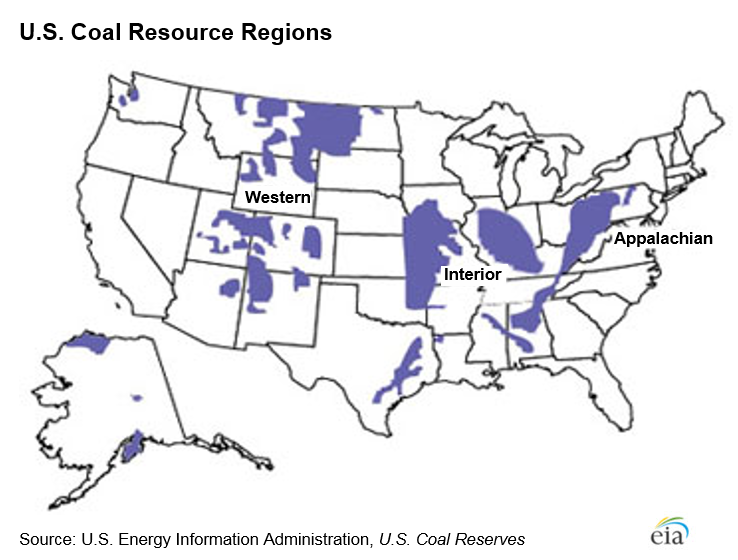
The amount of coal that exists in the United States is difficult to estimate because it is buried underground. In 1975, the U.S. Geological Survey (USGS) published the most comprehensive national assessment of U.S. coal resources, which indicated that as of January 1, 1974, coal resources in the United States totaled 4 trillion short tons. Although the USGS has conducted more recent regional assessments of U.S. coal resources, a new national-level assessment of U.S. coal resources has not been conducted.
EIA publishes three measures of how much coal is left in the United States. The measures are based on various degrees of geologic certainty and on the economic feasibility of mining the coal.
EIA's estimates for the amount of coal reserves as of January 1, 2023, by type of reserve are:1
- Demonstrated Reserve Base (DRB) is the sum of coal in both measured and indicated resource categories of reliability. The DRB represents 100% of the in-place coal that could be mined commercially at a given time. EIA estimates the DRB at about 470 billion short tons, of which about 69% is underground mineable coal.
- Estimated recoverable reserves include only the coal that can be mined with today's mining technology after considering accessibility constraints and recovery factors. EIA estimates U.S. recoverable coal reserves at about 250 billion short tons, of which about 58% is underground mineable coal.
- Recoverable reserves at producing mines are the amount of recoverable reserves that coal mining companies report to EIA for their U.S. coal mines that produced more than 25,000 short tons of coal in a year. EIA estimates these reserves at about 12 billion short tons of recoverable reserves, of which 53% is surface mineable coal.
Based on U.S. coal production in 2022, of about 0.594 billion short tons, the recoverable coal reserves would last about 422 years, and recoverable reserves at producing mines would last about 20 years. The actual number of years that those reserves will last depends on changes in production and reserves estimates.
What is the amount of world coal reserves?
As of December 31, 2021, estimates of total world proved recoverable reserves of coal were about 1,161 billion short tons (or about 1.16 trillion short tons), and five countries had about 75% of the world's proved coal reserves.
- The top five countries and their percentage share of world proved coal reserves as of December 31, 2021, were:2
- United States22%
- Russia15%
- Australia14%
- China14%
- India11%
1 Source: U.S. Energy Information Administration, Coal Reserves, October 2023.
2 Source: U.S. Energy Information Administration, International Energy Statistics, Coal reserves, as of October 24, 2023.
Last updated: October 24, 2023, with data available at the time of update.