
U.S. Coal Reserves
As of January 1, 2025, the demonstrated reserve base (DRB) contained about 468 billion short tons of coal. In the United States, coal resources are larger than remaining natural gas and oil resources, when measured by total British thermal units (Btu). Once a year, we report remaining tons of coal in the DRB, which consists of coal resources that have been identified to specified levels of accuracy.
Between 1990 and 1999, we obtained updated coal reserves information and data largely through our Coal Reserves Data Base (CRDB) program. That program encouraged state agencies to revise coal resource and reserves estimates for their respective states. Our more recent revised coal reserves estimates, however, include improved analyses of coal quality, accessibility, and recoverability in the study areas. We use these new data to revise the DRB.
Recovery rates vary greatly between underground and surface mining. The actual proportion of coal resources that can be recovered from undisturbed deposits varies from less than 40% in some underground mines to more than 90% at some surface mines. In some underground mines, a portion of the coal is intentionally left intact as pillars to protect against surface collapse. Adverse geologic features in a mining area, such as folding, faulting, and interlayered rock strata, can limit the amount of coal recovered at some underground and surface mines.
Access to some coal is limited. Because of property rights, land use conflicts, and physical and environmental restrictions, we estimate that only about 53% of the DRB may be available or accessible for mining.
We annually estimate recoverable coal reserves by adjusting the DRB to reflect accessibility and recovery rates in mining. As of January 1, 2025, we estimated that the remaining U.S. recoverable coal reserves totaled 249.4 billion short tons out of a DRB of 468.4 billion short tons.
Recoverable coal reserves represent the quantity of coal that can be recovered (that is, mined) from existing coal reserves at producing mines. These reserves essentially reflect the working inventory at producing mines. In 2023, the recoverable reserves at producing mines were 11.2 billion short tons. We conduct an annual survey, Form EIA-7A, Annual Survey of Coal Production and Preparation, to gather and report the quantity of recoverable coal reserves at producing mines.
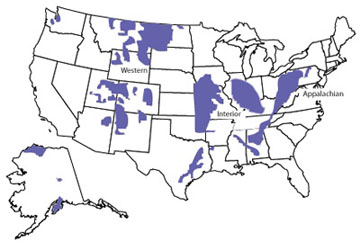
U.S. Coal Resource Regions
Data tables
Summary
- Table 14.Recoverable Coal Reserves at Producing Mines by State
- Table 15.Recoverable Coal Reserves at Producing Mines, Estimated Recoverable Reserves, and Demonstrated Reserve Base by Mining Method
- Table 16.Recoverable Coal Reserves at Producing Underground Coal Mines by State and Mining Method
- Table 17.Recoverable Coal Reserves at Producing U.S. Mines by Mine Production Range and Mine Type
- Previous issues
- 1997 Issue
- 1995 Issue
- 1992 Issue
- See also:
- Annual Coal Report