
The core of an atom
Atoms are tiny particles in the molecules that make up gases, liquids, and solids. Atoms are made up of three particles:
- Protons
- Neutrons
- Electrons
An atom has a nucleus (or core) that contains protons and neutrons, and the nucleus is surrounded by electrons. These particles all have different electrical charges:
- Protons carry a positive electrical charge.
- Electrons carry a negative electrical charge.
- Neutrons do not have an electrical charge.
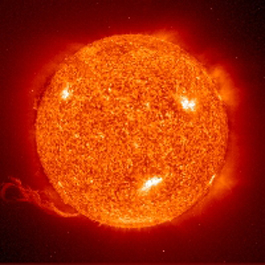
The sun is basically a giant ball of hydrogen gas undergoing fusion and giving off vast amounts of energy in the process.
Source: NASA (public domain)
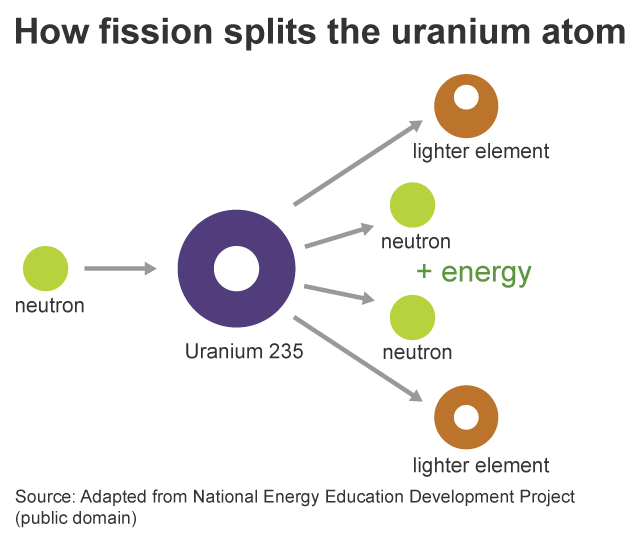
Enormous energy is present in the bonds that hold the particles inside the nucleus together. This nuclear energy is released when those bonds are broken. The bonds can be broken through nuclear fission, and this energy can be used to produce (generate) electricity.
Nuclear fission and nuclear fusion
In nuclear fission, atoms are split apart, which releases energy. All nuclear power plants use nuclear fission, and most nuclear power plants use uranium atoms. During nuclear fission, a neutron collides with a uranium atom and splits it, releasing a large amount of energy in the form of heat and radiation. More neutrons are also released when a uranium atom splits. These neutrons continue to collide with other uranium atoms, and the process continues repeating itself. This process is called a nuclear chain reaction. This reaction is controlled in nuclear power plant reactors to produce the amount of heat needed to generate electricity.
In nuclear fusion, atoms are combined, or fused, together to form a larger atom. Fusion is the source of energy in the sun and stars. Researchers are working to develop technology to harness nuclear fusion as a source of energy for heat and electricity generation. Whether fusion will be a commercially viable source of energy is not yet clear because of the difficulty in controlling a fusion reaction.
Nuclear fuel—uranium
Uranium is the fuel most widely used by nuclear plants for nuclear fission. Uranium is considered a nonrenewable energy source, even though it is a common metal found in rocks worldwide. Nuclear power plants use a certain kind of uranium, referred to as U-235, for fuel because its atoms are easily split apart. Although uranium is about 100 times more common than silver, U-235 is relatively rare.
Most U.S. uranium ore is mined in the western United States. Once uranium is mined, the U-235 must be extracted and processed before it can be used as a fuel.