
Heating with the sun's energy
We use the sun’s energy (solar thermal energy) for many things, including heating water, air, and the inside of buildings and generating electricity. There are two general types of solar heating systems: passive systems and active systems.
Passive solar heating systems
When the sun shines through the windows of a building and warms the interior, it’s called passive solar heating. Buildings designed for optimal passive solar heating usually have large windows facing south (in the Northern Hemisphere). The sun shines through the windows onto special walls or floors that absorb solar heat. These building materials then release the stored heat, warming the interior naturally. Window overhangs or shades block the sun from entering the windows during the summer to keep the building cool.
Active solar heating systems
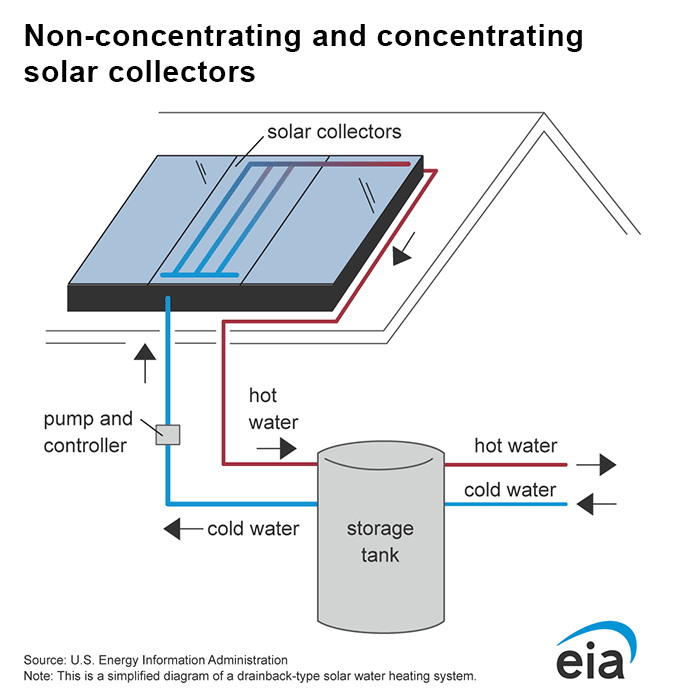
Active solar heating systems use fans or pumps to move air or liquid through collectors. The air or liquid is heated at the collector then flows into a building or heat-storage system, where the heat can be used later. The fans or pumps recirculate the air or liquid from the building or storage system back to the collector to be reheated. Active solar water heating systems usually have a tank for storing solar-heated water.
Types of solar collectors
Non-concentrating solar collectors
Typically, buildings that use solar energy systems have non-concentrating collectors, which means they don’t amplify the sunlight with mirrors or lenses. The surface collecting the sunlight is the same surface absorbing the solar energy. Flat-plate collectors are the most common type of non-concentrating collectors and are used when temperatures lower than 200°F are sufficient, for example, the solar panels on the roof of a home or building.
Flat-plate solar collectors usually have three main components:
- A flat metal plate that collects and absorbs solar energy
- A transparent cover that allows solar energy to pass through the cover and reduces heat loss from the absorber
- A layer of insulation on the back of the absorber to reduce heat loss
Solar water heaters use a metal pipe attached to the solar collector that runs in a loop from the collector, through a water storage tank, and back to the collector. A heat-transfer fluid flows through the metal pipe. The fluid inside the pipe absorbs heat at the collector, flows down through the tube, and then heats the water inside the storage tank. The fluid continuously moves through this loop, absorbing heat at the collector, heating the water in the tank, and returning to the solar collector to be reheated.
Solar systems for heating swimming pool water usually have flat-plate collectors that do not have covers or insulation for the collector, and the pool water circulates from the pool through the collector and back to the pool.
Solar air-heating systems use fans to move air through flat-plate collectors and into buildings.
Concentrating solar collectors
These systems have a highly reflective collector that focuses, or concentrates, solar energy onto an absorber. The collector usually moves during the day with the sun to keep the sunlight focused on the absorber. Solar thermal power plants use concentrating solar collector systems because they can produce the high-temperature heat needed to generate electricity.