
Tidal power in the United States
The gravitational pull of the moon and sun along with the rotation of the earth create tides in the oceans. In some places, tides cause water levels near the shore to rise and fall up to 40 feet. People in Europe harnessed this movement of water to operate grain mills more than 1,000 years ago. Today, tidal energy systems generate electricity. Producing tidal energy economically requires a tidal range of at least 10 feet.
The United States does not have any commercially operating tidal power plants. However, a few places in the United States have potential for tidal power, including Cook Inlet of Alaska, which has the second-highest tidal range in North America; several places in Maine; and in New York. Demonstration projects that have been implemented or are in various stages of development include:
- Roosevelt Island Tidal Energy (RITE) Project Pilot in the East River of New York
- Western Passage Tidal Energy Project in Maine
- Cobscook Bay Tidal Energy Project in Maine
Types of tidal energy systems
Three types of tidal energy systems are used around the world:
- Tidal barrages
- Tidal turbines
- Tidal fences
Tidal barrages
A barrage, which is similar to a dam, is installed across a tidal basin. A tidal basin is an inlet of an ocean bay or lagoon that fills with water during high tide and empties during low tide. Sluice gates on the barrage control water levels and flow rates to allow the tidal basin to fill on the incoming high tides and to empty through an electricity turbine system on the outgoing ebb during low tide. A two-way tidal power system generates electricity from both the incoming and outgoing tides.
A potential disadvantage of tidal power is the effect a tidal station can have on plants and animals in estuaries of the tidal basin. Tidal barrages can change the tidal level in the basin and increase turbidity (the amount of matter in suspension in the water). They can also affect navigation and recreation.
Several tidal power plants operate around the world. The largest is the Sihwa Lake Tidal Power Station in South Korea, at 254 megawatts (MW) of electricity-generation capacity. The oldest and second-largest operating tidal power plant is in La Rance, France, with 240 MW of electricity-generation capacity. Canada has the third-largest tidal power plant, at 20 MW of electricity-generation capacity, which is in Annapolis Royal in Nova Scotia. China, Russia, and South Korea also have tidal power plants.
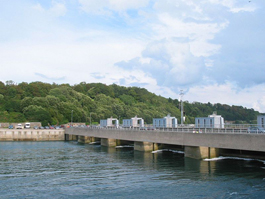
Barrage of the tidal power plant on the estuary of the Rance River in Bretagne, France
Source: Stock photography (copyrighted)
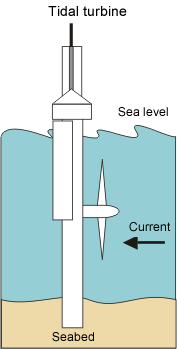
Source: Adapted from National Energy Education Development Project (public domain)
Tidal turbines
Tidal turbines are similar to wind turbines because they both have blades that turn a rotor to power a generator. They can be placed on the sea floor where the tidal flow is strong. Because water is about 800 times denser than air, tidal turbines must be much sturdier and heavier than wind turbines. Tidal turbines are more expensive to build than wind turbines but can capture more energy with the same size blades.
Tidal fences
A tidal fence has vertical-axis turbines mounted on the sea bed in a fence or row, similar to tidal turbines. Water passing through the turbines generates electricity.