
The electric power grid
Electricity is generated at power plants and then travels through a complex system, often called the grid. The grid includes electricity substations, transformers, and power lines that connect electricity producers and consumers. Most local grids are interconnected to each other, forming larger, reliable networks that ensure there is always enough electricity to meet demand.
In the United States, the electricity grid is made up of thousands of miles of high-voltage power lines and millions of miles of low-voltage power lines. This network connects thousands of power plants to hundreds of millions of electricity customers across the country.
Electricity sources and types of providers
The source of the electricity you buy varies. Some electric utilities generate all the electricity they sell using their own power plants. Other utilities buy electricity from different utilities, power marketers, independent power producers, or from wholesale markets.
The way electricity is sold to you varies from region to region. The company selling you power may be:
- A not-for-profit municipal electric utility (owned by the city or local government)
- An electric cooperative owned by its members (owned by stockholders, often called an investor-owned utility)
- A private, for-profit electric utility (owned by stockholders, often called an investor-owned utility)
In some states, electric utility customers can buy electricity directly from a power marketer, and a local utility delivers it. A few federally owned power authorities—including the Bonneville Power Administration and the Tennessee Valley Authority, among others—also generate, buy, sell, and distribute power. No matter the electricity’s source, local electric utilities operate the distribution system that connects homes and businesses to the grid.
Delivering electricity
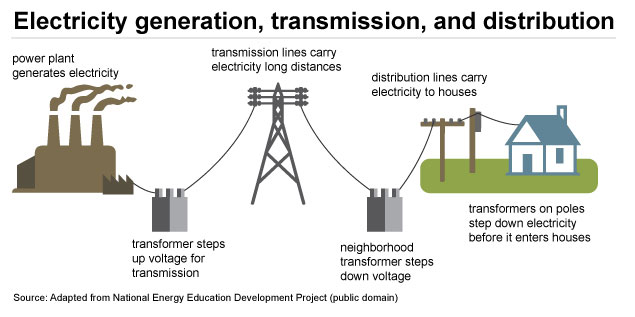
Power plants generate electricity, which they send to customers through transmission and distribution power lines.
- High-voltage transmission lines, such as those hanging between tall metal towers, carry electricity over long distances. Higher-voltage electricity makes long-distance electricity transmission more efficient and less expensive.
- Distribution transmission lines carry the lower-voltage electricity, which is safer to use in homes and businesses, and delivers it to customers.
- Transformers at substations play a crucial role. They either increase (step up) or reduce (step down) voltages to adjust to the different stages of the journey—from the power plant on long-distance transmission lines to the distribution lines that deliver electricity to homes and businesses.
Evolution of the electric power grid
At the beginning of the 20th century, more than 4,000 isolated electric utilities operated in the United States. As the demand for electricity grew, especially after World War II, these lone utilities began to connect their transmission systems to each other. These connections allowed utilities to share the economic benefits of building large and often jointly owned power plants to serve their combined electricity demand at the lowest possible cost. Interconnection also reduced the amount of extra generating capacity each utility had to have available to ensure reliable service during peak demand. Over time, three large, interconnected systems evolved in the United States.
U.S. electrical system interconnections
For the electricity grid to remain stable, the amount of electricity supplied must match electricity demand. To achieve this balance, the different organizations that operate different parts of the grid must work together.
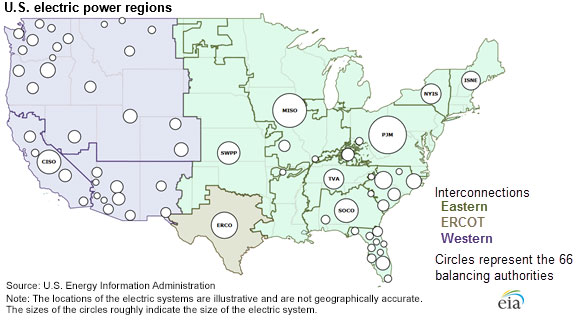
The U.S. electric grid in the Lower 48 states has three main interconnections. These interconnections mostly operate independently from each other and rarely transfer electricity among them:
- The Eastern Interconnection covers the area east of the Rocky Mountains and a part of the Texas panhandle.
- The Western Interconnection covers the area from the Rocky Mountains to the west.
- The Electric Reliability Council of Texas (ERCOT) covers most of Texas.
The Eastern and Western Interconnections are also linked to Canada's power grid. This network structure makes the grid more reliable by providing multiple paths for power to flow and allowing generators to supply electricity to many different areas. This redundancy helps prevent widespread blackouts if a transmission line or power plant fails.
Balancing authorities
The three major grid interconnections describe the physical structure of the grid. The day-to-day operation of the electric system within regions is managed by entities called balancing authorities. They ensure electricity supply constantly matches power demand. Most balancing authorities are electric utilities that have taken on the balancing responsibilities for their part of the power system. All regional transmission organizations in the United States also act as balancing authorities. ERCOT is unique because the balancing authority, interconnection, and regional transmission organization are all the same entity and physical system.
A balancing authority ensures that electricity demand and supply are precisely balanced to keep the grid safe and reliable. If electricity demand and supply fall out of balance, local or even widespread blackouts can happen. Balancing authorities maintain proper operating conditions by ensuring enough electricity is available for expected demand, which includes managing electricity transfers with other balancing authorities.
Electric reliability organizations
Electric utilities are responsible for keeping their systems safe and planning for future power needs. Initially, the electric power industry developed voluntary standards for coordination. Today, utilities have mandatory reliability standards for planning and operating power systems and for addressing security threats to critical electrical infrastructure. The North American Electric Reliability Corporation develops and enforces mandatory grid reliability standards, which are approved by the Federal Energy Regulatory Commission (FERC). Canada has its own regulators that fill this role.
Challenges facing the power grid
Construction of U.S. electricity infrastructure began in the early 1900s, driven by new technologies, central-station generating plants, and growing electricity demand, especially after World War II. Now, some of the older transmission and distribution lines have reached the end of their useful lives and must be replaced or upgraded. New power lines are also needed to maintain overall reliability and to connect to new renewable energy generation resources, such as wind and solar, which are often located far from cities, where electricity demand is highest.
Several challenges exist for improving the grid's infrastructure:
- Siting new transmission lines (getting approval for new routes and acquiring the necessary land can be difficult)
- Determining how to fairly recover the construction costs of a new transmission line built in one state when it also benefits customers in other states
- Addressing uncertainty in federal regulations about who pays for new transmission lines, which affects the ability of private companies to raise money for construction
- Expanding long-distance transmission lines to reach high-quality wind and solar resources, which are often far from population centers
- Protecting the grid from physical and cyber attacks