
Dams are not just for generating electricity
Most dams in the United States were built mainly for flood control, municipal water supply, and irrigation. Although many dams have hydroelectric generators, most dams were not built specifically for hydropower generation. Hydropower generators produce clean energy because they do not directly emit air pollutants. However, dams, reservoirs, and hydroelectric generators can affect the environment.
Dams have some environmental impact
A dam that creates a reservoir—diverts water to a run-of-river hydropower plant—may obstruct fish migration. A dam and reservoir can change natural water temperatures, water chemistry, river flow characteristics, and silt loads. These changes can affect the ecology and the physical characteristics of the river, which may negatively affect native plants and animals in and around the river.
Reservoirs may also cover important natural areas, agricultural land, or archeological sites. A reservoir or a dam’s operation may also result in relocating people. The physical location of a dam or reservoir, the dam operations, or using the river’s water can change the environment over a much larger area than the reservoir.
Dams have associated emissions
Manufacturing the concrete and steel in hydropower dams requires equipment that may produce emissions. If fossil fuels are an energy source for making these materials, then the emissions associated with those fuels could be associated with the electricity that hydropower facilities generate. However, given the long operating lifetime of a hydropower plant (50 years to 100 years), those construction emissions are offset by the emissions-free hydroelectricity.
Greenhouse gases (GHG) such as carbon dioxide and methane form in natural aquatic systems and in human-made water storage reservoirs as a result of the aerobic and anaerobic decomposition of biomass in the water. The exact amounts of GHG that form in and are emitted from hydropower reservoirs is uncertain and depend on many site-specific and regional factors.
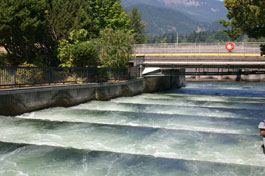
Fish ladder at the Bonneville Dam on the Columbia River separating Washington and Oregon
Source: Stock photography (copyrighted)
Fish ladders help fish reach their spawning grounds
Hydropower turbines kill and injure some of the fish that pass through the turbine. The U.S. Department of Energy has sponsored research and development of turbines that could reduce fish deaths to lower than 2%, compared with fish kills of 5% to 10% for the best existing turbines.
Many species of fish, such as salmon and shad, swim up rivers and streams from the sea to reproduce in their spawning grounds. Dams can block their way. Different approaches to fixing this problem include constructing fish ladders and elevators that help fish move around or over dams to the spawning grounds upstream.