
Hydrogen is the simplest element
Each atom of hydrogen has only one proton. Hydrogen is also the most abundant element in the universe. The sun, and other stars, are essentially giant balls of hydrogen and helium gases.
On earth, hydrogen occurs naturally combined with other elements in liquids, gases, or solids. Hydrogen combined with oxygen is water (H2O). Hydrogen combined with carbon forms different compounds—or hydrocarbons—that are found in natural gas, coal, and petroleum.
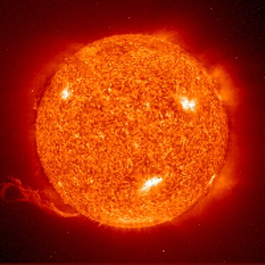
The sun is essentially a giant ball of hydrogen gas undergoing fusion into helium gas. This process causes the sun to produce vast amounts of energy.
Source: NASA (public domain)
Hydrogen is an energy carrier
Energy carriers transport energy in a usable form from one place to another. Elemental hydrogen is an energy carrier that generally presents as two hydrogen molecules (H2). Hydrogen can be produced, or separated, from a variety of sources—including water, fossil fuels, or biomass—and used as a source of energy or fuel. Hydrogen has the highest energy content of any common fuel by weight (about three times more than gasoline). However, it has the lowest energy content by volume as a liquid (about four times less than gasoline).
Producing hydrogen (by separating it from other elements) requires more energy than hydrogen provides when converted to useful energy. Despite this deficit, hydrogen is useful as a fuel due to its high energy content per unit of weight, which is why it is used as a rocket fuel and in fuel cells to produce electricity on some spacecraft. Although not widely used as a fuel now, it has significant potential for future use.
The U.S. Department of Energy's (DOE) Hydrogen Program has a number of participating offices and programs for hydrogen research, development, and deployment. One of the largest programs is the Regional Clean Hydrogen Hubs, sponsored by the Office of Clean Energy Demonstrations, to accelerate hydrogen use as an energy carrier for delivering and storing energy.