
Regional differences for cost of crude oil to refiners widened in 2011
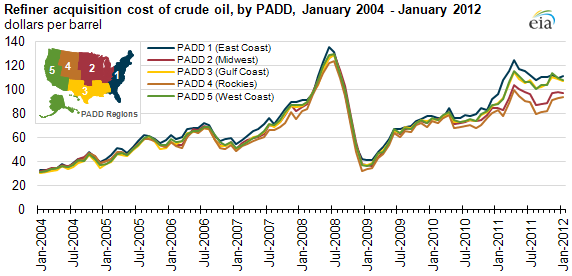
The cost of crude oil to refiners varies across regions based on the different types of crude oil available to refiners and transportation bottlenecks in that region. This cost, called the refiner acquisition cost, also includes transportation and other fees paid by the refiner. Historically, there has been little variation across regions. From 2004 through 2009, the average of the annual spread between the most expensive and least expensive regional refiner acquisition cost was $5.52 per barrel. In 2010, the spread was $7.46 per barrel, and in 2011, it widened dramatically to $23.78 per barrel.
The regional variation in the price of crude oil occurs because of transportation constraints coupled with increasing production. Variations in the refiner acquisition cost often result in changes to refinery utilization rates and to total gross inputs into refineries within regions.
Lower refiner acquisition costs can result in lower prices for retail petroleum products, higher profit margins for refiners, or both. Within the Midwest and Rockies, the regional average refiner acquisition costs were 8.6% and 14.1%, respectively, below the U.S. average annual refiner acquisition cost in 2011. Compared to other crude oil prices, the lower relative price of Bakken crude oil resulted in lower retail prices for gasoline and other petroleum products in the Rockies. In the Midwest, lower regional crude prices have not affected retail petroleum prices because the Midwest relies mainly on gasoline from the Gulf Coast as its marginal source of supply.
Higher refiner acquisition costs can result in lower refinery utilization rates and can affect decisions by refiners to idle capacity. On the East Coast, the regional average annual refiner acquisition cost was 9.2%, or $9.42 per barrel, above the U.S. average value in 2011, peaking in February 2011 at $16.99 per barrel above the U.S. average value. Two East Coast refineries idled capacity due to unfavorable refining economics, while another refiner may sell or shut down its facility.
Tags: Bakken, crude oil, diesel, gasoline, liquid fuels, Midwest, oil/petroleum, prices, refinery capacity, refining, Rockies, states