
Real U.S. gasoline prices this Thanksgiving are mostly unchanged from last year
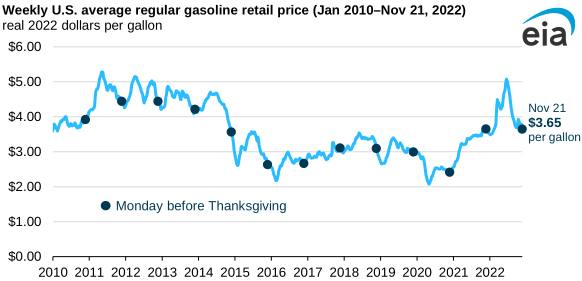
Consumers paid, on average, $3.65 per gallon (gal) at the pump for U.S. regular gasoline on November 21, the Monday before Thanksgiving. This year's Monday-before-Thanksgiving price is 7.5%, or $0.25/gal, higher than last year, which is the same as the overall consumer goods price increase of 7.7%, based on the Consumer Price Index (CPI).
U.S. retail gasoline prices typically follow a seasonal trend: prices increase in the summer, when people are driving more, and then decline in the winter. After reaching more than $5.00/gal this summer, prices declined into the autumn as a result of seasonal price trends as well as declines in both crude oil prices and crack spreads (the difference between spot petroleum product prices and crude oil prices).
This Thanksgiving, the American Automotive Association (AAA), forecasts that 54.6 million people will travel 50 miles or more over for the Thanksgiving holiday, a 1.5% increase from 2021.
U.S. gasoline prices vary regionally, reflecting local supply and demand conditions, fuel specifications required by state laws, and taxes.
Regional gasoline prices are usually the highest on the West Coast because of the region’s limited connections with other major refining centers, tight supply and demand conditions, and fuel specifications that make gasoline more costly to manufacture. On November 21, West Coast prices averaged $4.78/gal, a $0.59/gal (14%) increase compared with last year's Monday-before price.
The Rocky Mountain region faces many similar logistical constraints as the West Coast, although overall supply and demand in the region are both lower. On November 21, Rocky Mountain retail gasoline prices averaged $3.64/gal, a $0.11/gal (3%) increase compared with last year.
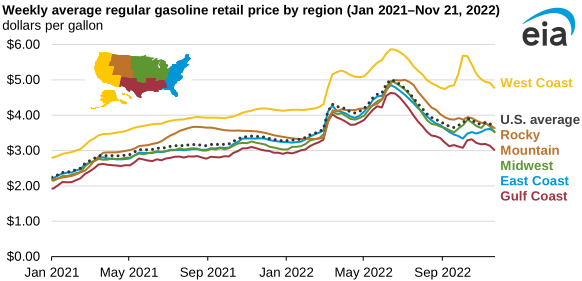
Unplanned refinery outages in the Midwest (including an extended outage at the BP-Cenovus refinery in Toledo, Ohio, following an explosion and fire) have contributed to comparatively higher retail gasoline prices in the region recently. On November 21, retail prices in the Midwest averaged $3.52/gal, a $0.32/gal (10%) increase compared with last year.
The average retail price on the East Coast, which typically tracks close to the U.S. average, fell to as low as $0.45/gal below the U.S. average in early October. On November 21, the price increased to $3.54/gal, a $0.19/gal (6%) increase compared to last year.
The Gulf Coast region, home to more than half of the nation’s refining capacity, typically has the lowest retail gasoline prices. On November 21, the Gulf Coast average retail gasoline price was $3.02/gal, a $0.01/gal (0%) decrease from last year.
Principal contributor: Jeff Barron
Tags: prices, gasoline, crack spread, diesel