
Nuclear, pumped storage, and coal power plants are more likely to have multiple owners
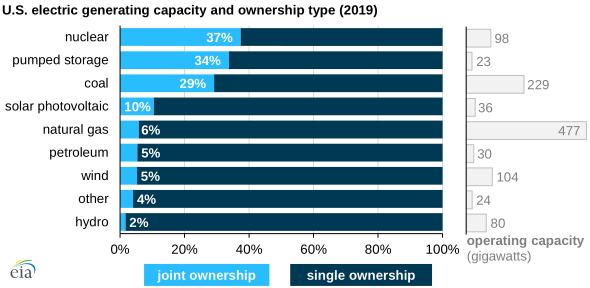
The U.S. Energy Information Administration (EIA) collects data on whether an electric generator is owned by one company or jointly owned by several companies, and for those jointly owned, each owner’s share of ownership. In 2019, about 14% of the 1,099 gigawatts (GW) of total operational U.S. electricity generating capacity was jointly owned. Nuclear capacity had the highest percentage of joint ownership at 37%, followed by pumped-storage hydropower at 34% and coal at 29%. These types of power plants tend to be large-scale facilities that are expensive to build, and the technologies come with higher regulatory risks, making joint ownership more attractive by reducing plant ownership risks for each owner.
Joint ownership reduces risk by sharing construction and operation costs across multiple entities. A joint venture spreads the cost and risk across entities while allowing them to benefit from capacity portfolio diversity and the economies of scale that large generation assets provide. Complementary expertise from different entities can also potentially increase development and operational efficiency.
In 2019, 58 nuclear power plants with a total of 96 nuclear reactors were operating in the United States. The largest U.S. nuclear power plant, Palo Verde in Arizona, has seven joint owners. These owners include utilities from Arizona, California, Texas, and New Mexico. The ownership percentages in Palo Verde range from 29% to 6%.
The only nuclear reactors under construction in the United States are Units 3 and 4 at Vogtle nuclear power plant in Georgia. Once completed, Vogtle will be the largest nuclear power plant in the country. Vogtle is jointly owned by four entities: Georgia Power (46% ownership), Oglethorpe Power (30%), the Municipal Electric Authority of Georgia (23%), and Dalton Utilities (2%).
Pumped-storage hydropower and conventional hydropower are technologies that are similar to one another, but they have very different ownership profiles. Only 2% of conventional hydropower capacity was jointly owned in 2019, compared with 34% for pumped storage. Almost 64% of U.S. conventional hydroelectric capacity is owned by a single federal, state, or municipal government. Another 19% is owned by a single electric utility.
Most conventional hydroelectric plants were built between 1950 and 1980, when hydropower project funding mainly came from the federal government. Conversely, most pumped storage became operational in the 1970s and 1980s when the industry and markets supported investors constructing large capital projects. The two largest pumped-storage plants, Bath County (3.0 GW) and Ludington (2.3 GW), which together represent 22% of total U.S. pumped-storage capacity, are jointly owned.
Principal contributor: Ray Chen
Tags: generation, storage, coal, electricity, nuclear, power plants