
U.S. crude oil production in May has a record monthly decrease
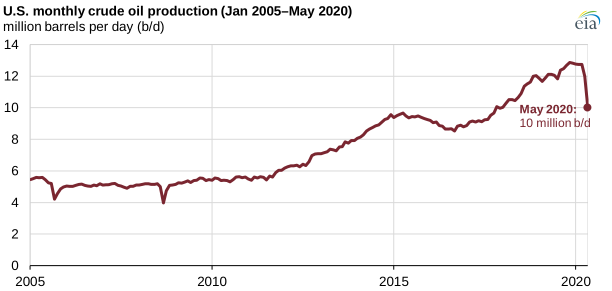
Production of crude oil decreased in the United States in May 2020 by 1.99 million barrels per day (b/d), the largest monthly decrease since at least January 1980, according to the U.S. Energy Information Administration’s (EIA) Monthly Crude Oil and Natural Gas Production Report. This decrease surpassed the previous record drop in September 2008 when Hurricanes Gustav and Ike caused production to fall by 1.03 million b/d. May marks the sixth consecutive monthly decrease in crude oil production and is the third month since the March 2020 declaration of a national emergency concerning the coronavirus disease (COVID-19) outbreak.
May crude oil production decreased by 16.6% as the economic impact of COVID-19 mitigation efforts led to a drop in demand. Reduced economic activity related to COVID-19 mitigation efforts has caused changes in energy supply and demand patterns. Crude oil producers curtailed production and reduced drilling activity, lowering the output for the major U.S. oil-producing regions. The benchmark West Texas Intermediate (WTI) crude oil average spot price dropped from $58 dollars per barrel (b) in January 2020 to $17/b in April; however, WTI increased to $29/b in May as production decreased and demand increased.
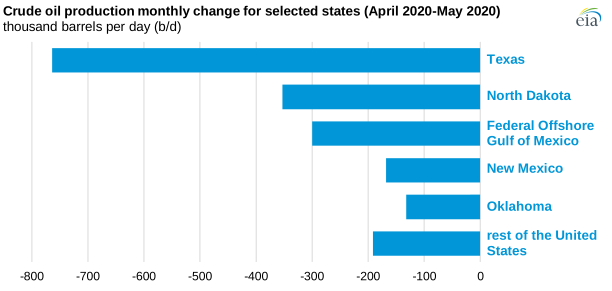
Texas had the largest decrease in crude oil production from April to May 2020 among states and producing regions at 764,000 b/d, a 14.8% decrease. More crude oil is produced in Texas than in any other state or region of the United States; Texas accounted for 41% of the national total in 2019. North Dakota saw the second-largest decrease, 353,000 b/d, and had the largest percentage drop at 29.1%. Texas, North Dakota, New Mexico, Oklahoma, and Wyoming had record monthly crude oil production decreases in May.
EIA expects U.S. crude oil production to rise in July 2020 as demand and prices increase. In its July Short-Term Energy Outlook (STEO), EIA forecasts that U.S. crude oil production will average 11.6 million barrels per day (b/d) in 2020. Before the COVID-19 pandemic and the economic downturn, U.S. crude oil production averaged 12.8 million b/d in the first two months of 2020.
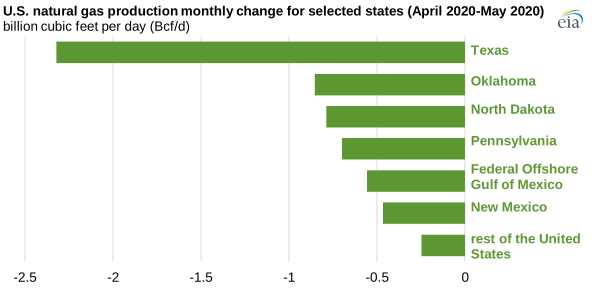
U.S. natural gas production decreased 5.9 billion cubic feet per day (Bcf/d), or 5.3%, from April to May. The May decrease is the second-largest monthly decrease in U.S. natural gas production on record. The largest decrease occurred in September 2008 when Hurricanes Gustav and Ike caused production to fall by 6.8 Bcf/d.
Texas saw the largest regional monthly decrease for natural gas production in May, decreasing by 2.3 Bcf/d, or 8.1%. Texas, Oklahoma, North Dakota, Pennsylvania, and New Mexico each had record monthly drops in natural gas production in May.
EIA forecasts that U.S. marketed natural gas production—which it defines as gross withdrawals of natural gas less natural gas used for repressuring reservoirs, quantities vented or flared, and nonhydrocarbon gases removed in treating or processing operations—will continue to decline for the remainder of 2020.
Principal contributor: Emily Geary