U.S. Energy Information Administration logo
Skip to sub-navigation
March 2, 2018

West Coast jet fuel imports increase to meet growing demand
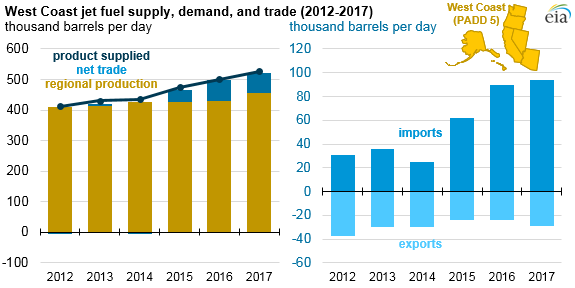
west coast jet fuel supply, demand, and trade, as explained in the article text
Source: U.S. Energy Information Administration, Petroleum Supply Monthly

Net imports of jet fuel into the West Coast (defined as Petroleum Administration for Defense District, or PADD, 5) have increased in recent years as regional jet fuel consumption has outpaced production. States in the West Coast region—those bordering the Pacific Ocean plus Nevada and Arizona—make up about 20% of the U.S. population but account for nearly a third of U.S. jet fuel consumption. Most of these jet fuel imports have come from refineries in Asia.

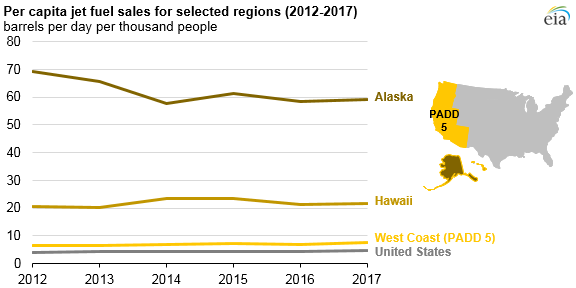
West Coast jet fuel consumption increased by 6% in 2016 and by another 5% in 2017, averaging 527,000 barrels per day (b/d) through December. In particular, Alaska and Hawaii have higher per capita jet fuel use because of their remote locations, using thirteen and five times the national average, respectively.
per capita jet fuel sales for selected regions, as explained in the article text
Source: U.S. Energy Information Administration, Petroleum Supply Monthly, U.S. Census Bureau
Note: Alaska and Hawaii data originate from prime supplier data. U.S. and PADD 5 data originate from product supplied data.

A number of factors have driven increases in jet fuel consumption since 2014. The average jet fuel price dropped to $1.53 per gallon in 2015, compared with an average price of $2.92 from 2012 to 2014, mostly because of lower crude oil prices. In addition to reduced jet fuel prices, economic and population growth since 2012 in the West Coast region have been higher than the U.S. average.

Because of the West Coast’s relative isolation from areas of production, higher imports have largely met the region’s increasing jet fuel demand. From 2012 through 2014, nearly all (98%) of the region’s jet fuel demand was met by production within West Coast states. This share fell to 87% from 2015 through 2017 as consumption increased.

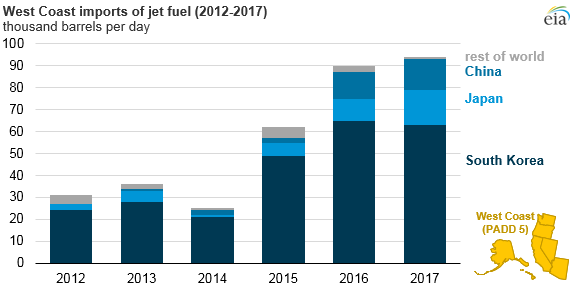
Increased imports of jet fuel into the West Coast created an opportunity for Asian refineries to supply jet fuel to the region. These imports came primarily from South Korea, China, and Japan. In 2016, West Coast jet fuel imports from these three countries totaled 87,000 b/d, or 96% of total jet fuel imports into the West Coast. In 2017, West Coast jet fuel imports from these countries increased again, reaching 93,000 b/d and accounting for 99% of total imports into the region.
west coast imports of jet fuel, as explained in the article text
Source: U.S. Energy Information Administration, Petroleum Supply Monthly

Principal contributor: Neil Agarwal

Statistics
Analysis
Tools
Education
News

Petroleum & Other Liquids

Crude oil, gasoline, heating oil, diesel, propane, and other liquids including biofuels and natural gas liquids.

Natural Gas

Exploration and reserves, storage, imports and exports, production, prices, sales.

Electricity

Sales, revenue and prices, power plants, fuel use, stocks, generation, trade, demand & emissions.

Coal

Reserves, production, prices, employment and productivity, distribution, stocks, imports and exports.

Nuclear & Uranium

Uranium fuel, nuclear reactors, generation, spent fuel.

Renewable & Alternative Fuels

Includes hydropower, solar, wind, geothermal, biomass and ethanol.

EIA Survey Forms

Forms EIA uses to collect energy data including descriptions, links to survey instructions, and additional information.

Total Energy

Comprehensive data summaries, comparisons, analysis, and projections integrated across all energy sources.

U.S. States

State energy information, including overviews, rankings, data, and analyses.

International

International energy information, including overviews, rankings, data, and analyses.

Environment

Greenhouse gas data, voluntary reporting, electric power plant emissions.

Data Tools, Apps, & Maps

Tools to customize searches, view specific data sets, study detailed documentation, and access time-series data.

Open Data

EIA's free and open data available as API, Excel add-in, bulk files, and widgets

EIA Beta

Come test out some of the products still in development and let us know what you think!

Open Source Code

EIA's open source code, available on GitHub.

RSS Feeds

Subscribe to feeds for updates on EIA products including Today in Energy and What's New.