
Lower airline fuel costs reduce U.S. airlines’ operating expenses, increase net profits
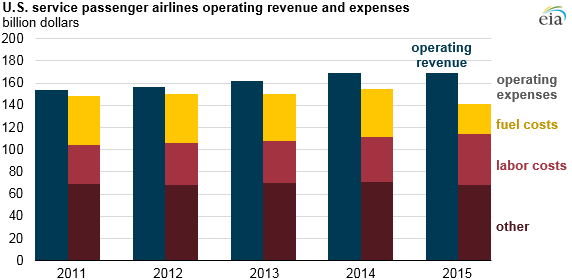
Lower crude oil prices in recent years have translated to lower fuel costs and overall lower operating expenses for U.S. passenger airlines. According to the U.S. Department of Transportation’s Bureau of Transportation Statistics (BTS), U.S. passenger airlines’ collective net profit increased to $25.6 billion in 2015, up from $7.5 billion in 2014. Much of that increase is attributed to lower expenditures for kerosene-based aviation fuels, which fell by $16.5 billion from 2014 to 2015. Jet fuel spot prices remained favorable for airlines in 2016, averaging $1.25 per gallon, compared to an average of $1.53 per gallon in 2015, well below the average of $2.92 per gallon over the 2011–14 period.
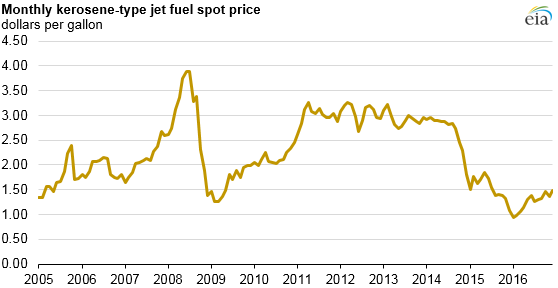
As a share of total operating expenses, the cost of labor was nearly equal to fuel expenses in 2014. Fuel costs decreased significantly in 2015 as jet fuel prices declined. Many airlines hedge their fuel expenses by locking in fuel prices as insurance against the volatile nature of fuel prices; however, these fuel hedging efforts likely declined as fuel prices trended downward.
Recent increases in airlines’ net profits have likely lessened capital constraints on efforts to modernize commercial fleets through purchases or leases of new, more fuel-efficient aircraft. During periods of rapidly increasing jet fuel prices, airlines are also motivated to introduce cost-saving measures, such as increasing the efficiency of their operations and fleets. Operational changes such as increasing flight load factors (i.e., reducing the number of empty seats) and changing the routes and speeds flown can also increase fuel efficiency.
According to the International Council on Clean Transportation, global commercial aircraft average fuel efficiency (measured as fuel consumed per passenger-mile) for new aircraft improved 1.3% per year on average from 1968 through 2014. Aircraft fuel efficiency varies based on aircraft range, size, and operation economics (e.g., seating capacity).
New aircraft, whether they are acquired to expand capacity or replace existing capacity, are significantly more efficient than the average aircraft in the existing commercial fleet. For this reason, policies that may encourage more turnover of the existing fleet, including policies that affect aircraft emissions and noise standards, can accelerate improvement in fleet-wide efficiency.
Principal contributor: Mark Schipper