
EIA celebrates 20 years on the Internet
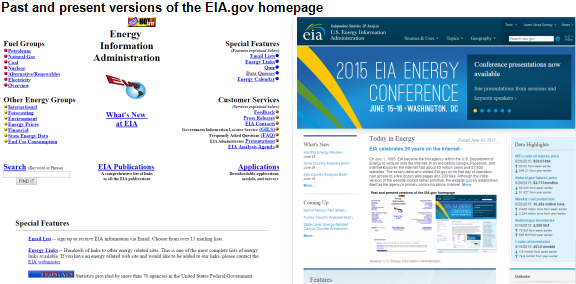
Note: Click to enlarge.
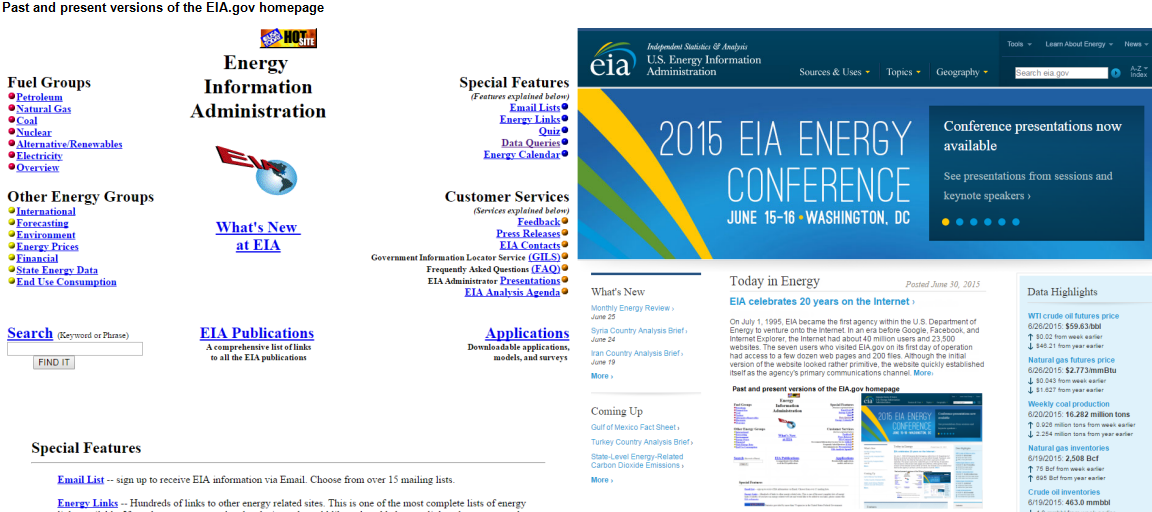
On July 1, 1995, the U.S. Energy Information Administration (EIA) became the first agency within the U.S. Department of Energy to venture onto the Internet. In an era before Google, Facebook, and Internet Explorer, the Internet had about 40 million users and 23,500 websites. The seven users who visited EIA.gov on its first day of operation had access to a few dozen web pages and 200 files. Although the initial version of the website looked rather primitive, the website quickly established itself as the agency's primary communications channel.
The number of visitors to EIA.gov each month has grown from a few thousand in the website's first year to about 1.5-2.0 million currently. EIA's total email subscriber base grew from 2,000 to more than 520,000. EIA.gov now provides approximately 207,000 web pages, 41 email subscription lists, 11 RSS feeds, and more than 1.2 million data series in its application programming interface (API). Correspondingly, the number of EIA print publications has decreased from more than 80 in 1995, to 5 publications in 2005, to just 2 today.
Over the past 20 years, EIA's online tools have evolved to make EIA's data and analysis more accessible, understandable, relevant, and responsive to customer needs. EIA has developed a series of interactive, database-driven applications such as data browsers for specific fuels (electricity, coal) and EIA forecasts (Short-Term Energy Outlook, Annual Energy Outlook). EIA also has developed several mapping tools such as the U.S. Energy Mapping System, the Crude Oil Imports Tracking Tool, the Energy Disruptions Map, the International Energy Portal, the U.S. Movements of Crude Oil by Rail page, and the Flood Vulnerability Assessment Map. EIA has also worked to make its data and visualizations available through a Microsoft Excel data add-in and the energy visualization widget.
One of the biggest changes to EIA.gov occurred in February 2011, when EIA launched a complete website redesign and agency rebranding effort. The new website introduced an emphasis on topical, timely content, centered around a new product; Today in Energy, one of the few daily publications from any U.S. government source. In 2012, EIA strengthened its commitment to open data by introducing a Beta site that enables the agency to crowd test innovative products before they are officially launched, and by offering an API that allows developers to design web and mobile apps based on EIA's energy data.
View and share EIA's Internet anniversary video
Principal contributor: Gina Pearson