
Guyana becomes key contributor to global crude oil supply growth
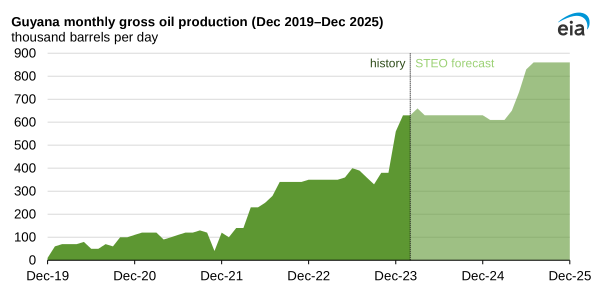
Guyana, situated on South America's northern coast neighboring Venezuela, Suriname, and Brazil, has emerged as a significant contributor to growth in the global supply of crude oil. Since starting production in 2019, Guyana has increased its crude oil production to 645,000 barrels per day (b/d) as of early 2024, all from the Stabroek block.
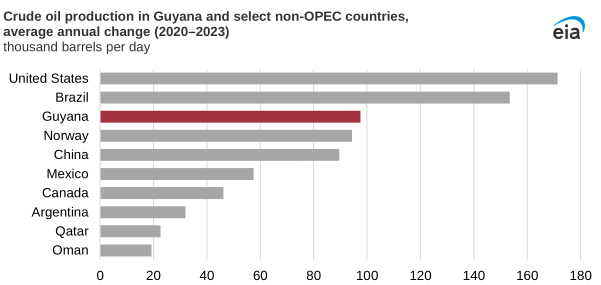
Guyana increased crude oil production by an annual average of 98,000 b/d from 2020 to 2023, making it the third-fastest growing non-OPEC producing country during this period. Crude oil production has been the largest contributor to Guyana’s economic growth in recent years. In 2022, Guyana’s GDP grew by 62.3%, the highest real GDP growth in the world that year, according to the International Monetary Fund (IMF).
Guyana's most recent estimate of recoverable oil and natural gas resources is more than 11 billion oil-equivalent barrels, and developers are still exploring the country’s offshore waters. Guyana's discovered oil and natural gas resources are currently located offshore within the Guyana-Suriname Basin of the Atlantic Ocean.
The first significant oil discovery in offshore Guyana was made by ExxonMobil in 2015 at what is now the Liza project in the Stabroek block. Since then, ExxonMobil and its partners, Hess and the China National Offshore Oil Corporation (CNOOC), have made more than 30 additional offshore oil and natural gas discoveries within the Stabroek block.
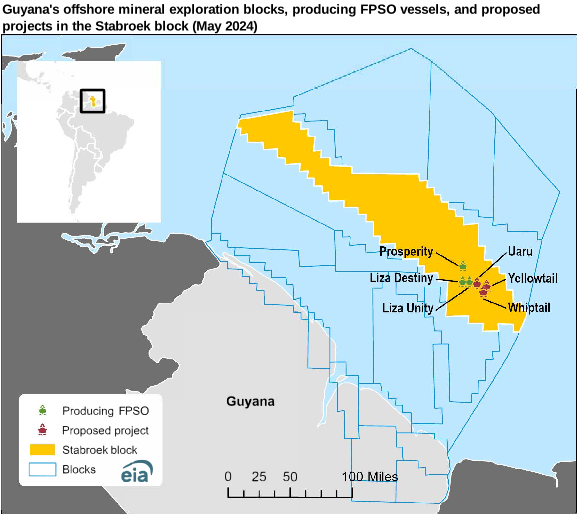
Note: FPSO=floating production, storage, and offloading
Guyana's oil production comes from three floating production, storage, and offloading (FPSO) vessels: Liza Destiny, Liza Unity, and Prosperity. These vessels produce oil and natural gas from the Liza and Payara projects. All associated natural gas is reinjected into wells to support its production and used as on-site fuel. A proposed project would bring associated natural gas onshore to processing facilities via pipeline.
Currently, the block’s partners plan for the combined production capacity to reach approximately 1.3 million b/d by the end of 2027, with plans to develop three additional projects: Yellowtail, Uaru, and Whiptail. If realized, the increased production would make Guyana the second-largest crude oil producer in Central America and South America behind Brazil.
The future of the corporate partnership at the Stabroek block is uncertain. Chevron's acquisition of Hess, which holds a 30% stake in the Stabroek block, may face delays due to arbitration filings by existing block partners ExxonMobil and CNOOC, which claim preemption rights over Hess’s stake in the block. ExxonMobil holds a 45% interest in the Stabroek block, and CNOOC holds a 25% stake.
Exploration operations in the Stabroek block and nearby offshore blocks may be affected by Venezuela’s claim of sovereignty over the Essequibo region, which accounts for more than two-thirds of Guyana’s land area. The International Court of Justice (ICJ) ruled in December that Venezuela should not take any action to interrupt the status quo while the ICJ hears the case.
Principal contributors: Eulalia Munoz-Cortijo, Matias Arnal