
U.S. uranium production up in 2022 after reaching record lows in 2021
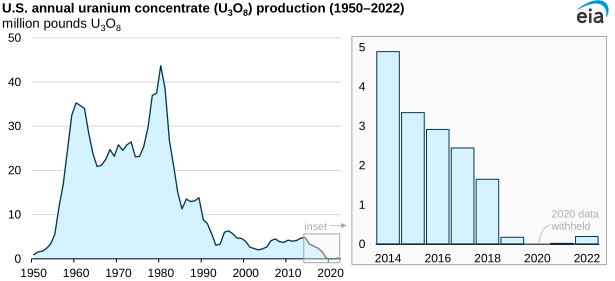
Note: Data for 2020 withheld to avoid disclosure of individual company data.
Uranium concentrate (U3O8) production in the United States was nearly 10 times higher than the previous year in 2022, partly as a result of higher uranium prices. U.S. U3O8 production remained near historic lows despite operations resuming at the White Mesa Mill, the United States’ only operating conventional uranium mill.
Using different processes, five facilities in the United States produced U3O8 in 2022. Despite only reporting production in the last three months of 2022, White Mesa accounted for 84% of the U3O8 produced last year. The rest was produced at four in situ recovery facilities. White Mesa operates on a campaign basis; it only produces U3O8 as when mill feed, contract requirements, or market conditions warrant. It can also process other minerals, including rare earths. In 2021, White Mesa focused on ramping up rare earth carbonate production and didn’t produce any U3O8.
Producing U3O8—often called yellowcake for its powdered, yellow appearance—is one of the first steps in making fuel for nuclear reactors. After uranium ore is mined, it goes through a milling process where uranium is extracted from the ore, producing U3O8, which is then processed at conversion and enrichment facilities. The enriched uranium is made into fuel pellets that are assembled into fuel rods for nuclear reactors.
In the 1940s and 1950s, the United States introduced financial incentives, procurement programs, and trade policies to help spur domestic uranium production. Domestic U3O8 production significantly declined in the 1980s as production incentives and subsidies ended, trade barriers were removed, and uranium prices fell. Since then, most of the uranium material supplied to U.S. nuclear plants has been imported.
The uranium material used in U.S. nuclear power reactors is largely imported because it’s more abundant and cheaper to produce in other countries. In 2022, 95% of the uranium purchased by U.S. nuclear power plant operators originated in other countries. Canada, which has large, high-quality uranium reserves, was the largest source of uranium purchased by U.S. nuclear power plants in 2022 at 27%. Kazakhstan was the second-largest source at 25%, followed by Russia at 12%.
Although the United States banned imports of oil, natural gas, and coal from Russia following Russia’s full-scale invasion of Ukraine in February 2022, uranium was not sanctioned.
The U.S. Department of Energy has announced its aim to increase domestic uranium production to reduce reliance on uranium imports. In 2020, Congress established a strategic uranium reserve, a stockpile of domestically produced uranium that serves as backup supply for U.S. nuclear power plants and incentivizes domestic uranium production. At the end of 2022, the U.S. Department of Energy awarded the first U3O8 supply contracts for the reserve, including one to White Mesa’s operator, Energy Fuels.
Principal contributors: Slade Johnson, Elesia Fasching
Tags: uranium, production/supply, nuclear