
The least U.S. interstate natural gas pipeline capacity on record was added in 2022
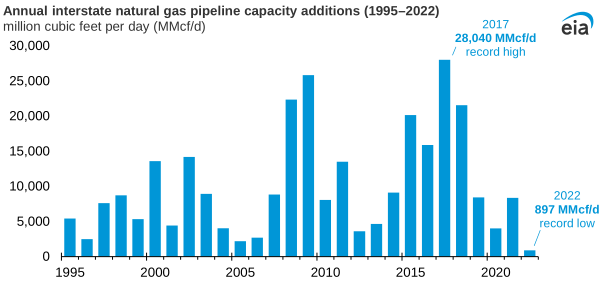
In 2022, 897 million cubic feet per day (MMcf/d) of interstate natural gas pipeline capacity was added collectively from five projects, according to our latest State-to-State Capacity Tracker, which contains information on the capacity of natural gas pipelines that cross state and international borders. In 2022, the least interstate natural gas pipeline capacity was added since we began data collection in 1995. However, capacity was added to intrastate pipelines and to existing FERC-administered interstate pipelines as expansions that increased intrastate capacity in 2022.
Interstate capacity additions were low in 2022 for two primary reasons:
- More growth in intrastate capacity (which are not captured in our interstate data)
- Less overall capital expenditures by oil and natural gas companies
In prior years, interstate pipeline capacity was added from looping and compressor station projects that were designed to accommodate growing Appalachia production. These types of projects were the most common for developing new interstate pipelines, but all of the planned projects are mostly completed. Since 2017, about 70% of the growth in natural gas production has come from the Permian and Haynesville regions, located near liquefied natural gas (LNG) export terminals along the Gulf Coast. In Texas and Louisiana, intrastate projects, rather than interstate projects, have increased takeaway capacity and connected natural gas production to LNG export terminals.
Building large-scale, commercial natural gas pipelines that cross state boundaries involves a number of contractual, engineering, regulatory, and financial requirements. These requirements may involve more coordination and can take longer to complete compared with intrastate pipeline projects.
In 2022, five projects increased interstate capacity to transport natural gas. The projects focused primarily on upgrading compressor stations, with only one project adding a relatively small amount of new pipe:
- Columbia Gulf Transmission’s Louisiana XPress Project increased its capacity from Mississippi to Louisiana by 493 MMcf/d and from Tennessee to Mississippi by 50 MMcf/d by adding or upgrading compressor stations to increase the deliverability of natural gas from the Appalachian Basin.
- Florida Gas Transmission’s Mobile County Project increased its capacity west-to-east from Mississippi to Mobile County, Alabama, by 175 MMcf/d by modifying the CS10 compressor station in Perry County, Mississippi.
- Florida Gas Transmission’s Southwest Alabama Project increased capacity from Mississippi to Escambia County, Alabama, by 100 MMcf/d by upgrading a compressor station.
- ANR Pipeline Company’s Wisconsin Access Project increased capacity from Illinois to Wisconsin by 51 MMcf/d by upgrading several meter and filtering stations on the ANR Pipeline, alleviating constraints in parts of northern and central Wisconsin.
- Gulfstream Natural Gas’s Gulfstream Phase VI Expansion Project increased capacity by 28 MMcf/d between Alabama and Tampa Electric Company’s Big Bend Power Plant in Florida by installing about four miles of pipe and a booster compressor station.
Principal contributor: Stephen York
Tags: natural gas, pipelines, states, capacity