
Public U.S. oil producers saw higher revenues and higher operational costs during Q1 2022
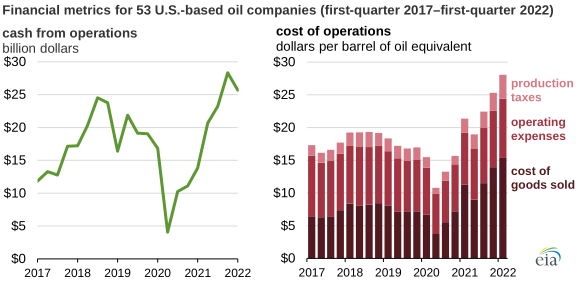
In the first quarter of 2022, 53 U.S. exploration and production companies reported both higher revenues and higher material and labor costs compared with the first quarter of 2021.
We base our analysis on the published financial reports of 53 publicly traded oil companies that produce a majority of their crude oil in the United States. As a result, our observations do not represent the sector as a whole because the analysis does not include private companies that do not publish financial reports. In the first quarter of 2022, these 53 publicly traded companies collectively produced 3.9 million barrels per day (b/d) of crude oil in the United States, or about 34% of all U.S. crude oil produced in the quarter.
The West Texas Intermediate (WTI) crude oil price averaged $95.18 per barrel (b) during the first quarter of 2022, up 64% from the first quarter of 2021 and up 23% from the fourth quarter of 2021. Cash from operations for these companies totaled $25.7 billion during the first quarter of 2022, which was 86% more than in the first quarter of 2021 and 9% less than in the fourth quarter of 2021. Despite higher revenues (an unusually high $8.8 billion increase in accounts receivable), the balance due for delivered goods not yet paid for by customers contributed to the quarterly decrease in cash from operations.
Capital expenditures by these companies nearly doubled year over year to reach $14.6 billion during the first quarter of 2022. These companies reported a 5% decline in capital expenditures in second-quarter 2022 compared with the first quarter. Production of crude oil remained flat compared with the fourth quarter of 2021, although it was 10% higher than in the first quarter of last year. Compared with pre-pandemic levels, production in the first quarter of 2022 was 10% less than in the first quarter of 2020.
Although rising crude oil prices increased revenues during the first quarter of 2022, supply chain issues and financial losses from hedging contributed to increased costs. Production expenses, such as the cost of goods sold, operating expenses, and production taxes, totaled $28.06 per barrel of oil equivalent in the first quarter of this year, 59% more than the pre-pandemic average and the highest for any quarter during the past five years. Cost of goods sold, which includes the cost of materials and labor directly used in production, have more than doubled from the pre-pandemic average.
A recent survey of oil and natural gas firms by the Federal Reserve Bank of Dallas found 94% believe supply-chain issues are having a negative impact on their firm, and 66% expect that it will take more than a year to resolve these issues.
Principal contributor: Alex DeKeyserling