
California’s curtailments of solar electricity generation continue to increase
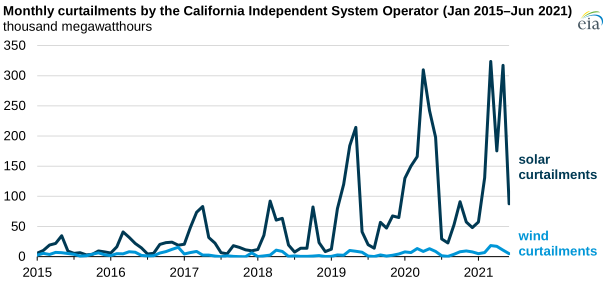
Curtailments of solar-powered electricity generation have increased in the California Independent System Operator (CAISO) region, the part of the electric grid that covers most of the state. In 2020, CAISO curtailed 1.5 million megawatthours of utility-scale solar, or 5% of its utility-scale solar production.
Grid operators curtail electricity production from solar and wind generators when supply exceeds demand. In 2020, solar curtailments accounted for 94% of the total energy curtailed in CAISO. Solar curtailments tend to be greater in the spring months when electricity demand is relatively low (because of moderate temperatures decreasing heating and cooling demand) and solar output is relatively high. In the early afternoon hours of March 2021, CAISO curtailed an average of 15% of its utility-scale solar output.
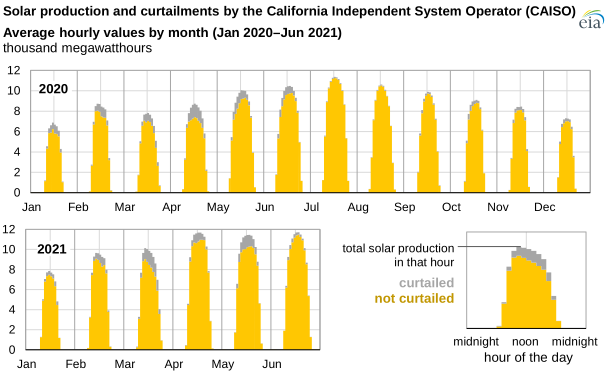
Increases in renewable generation and curtailments of solar and wind have followed an increase in new renewable capacity additions. To help meet California’s target of 50% renewable generation by 2025, CAISO plans to add another 1.6 gigawatts (GW) of utility-scale solar capacity and 0.4 GW of onshore wind turbine capacity in 2021. Combined, these two technologies represent 44% of CAISO’s total capacity additions in 2021.
Small-scale solar capacity has also continued to grow. Customer-sited solar generation decreases the need for CAISO-operated generation, leading to more solar curtailments.
CAISO has been exploring and implementing various solutions, including:
CAISO’s Energy Imbalance Market (EIM): CAISO’s EIM is a real-time market that allows participants outside of CAISO to buy and sell energy to balance demand and supply. In 2020, 16% of total possible curtailments were avoided by trade within the EIM, according to reports produced by the EIM operators.
Battery storage: CAISO is expecting to add 2.5 GW of battery storage capacity in 2021, according to our survey of recent and planned capacity changes. Renewable generators can charge these batteries with electricity that would otherwise have been curtailed.
Other energy storage options: Hydrogen production and hydrogen-based energy storage could also help reduce solar curtailments. The hydrogen will be produced by electrolysis using surplus renewable electricity that would otherwise be curtailed, and it will be stored for later use. Two projects in development are a power-to-gas-to-power project and a project by the Intermountain Power Project (IPP) called IPP Renewed. IPP Renewed focuses on developing renewable-powered hydrogen production and storage capabilities as well as installing natural gas-fired generators capable of using hydrogen.
Other solutions CAISO has identified include:
- Increasing demand response, which would adjust consumer demand when warranted
- Encouraging time-of-use rates, which better match consumer prices with real-time energy prices
- Reducing minimum generation levels for existing generators, which would allow greater opportunity for renewable energy production
Principal contributor: Lori Aniti
Tags: generation, electricity, solar, California, states