
The United States briefly returned to net importer status for petroleum earlier this year
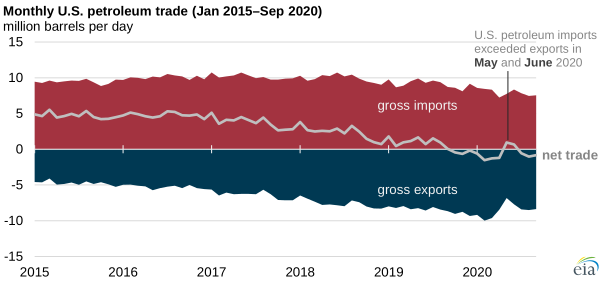
The United States imported more crude oil and petroleum products than it exported in May and June of this year, briefly reversing the country’s 15-year-long trend toward becoming a net petroleum exporter. After being a net petroleum exporter for seven consecutive months from October 2019 through April 2020, the United States became a net importer, and U.S. net petroleum imports averaged 939,000 barrels per day (b/d) in May and 675,000 b/d in June. On an annual basis, U.S. net imports of petroleum have fallen from a high of 12.5 million b/d in 2005 to 0.7 million b/d in 2019.
The brief return to net imports was a result of declines in both U.S. crude oil production and in refinery runs that resulted in lower gross crude oil and petroleum product exports because of lower global petroleum demand and economic responses to COVID-19. In April 2020, U.S. consumption of petroleum fell to its lowest level in decades as responses to the COVID-19 pandemic led to significant declines in travel. As petroleum demand fell, both domestically and internationally, U.S. refineries decreased crude oil processing and produced smaller volumes of petroleum products.
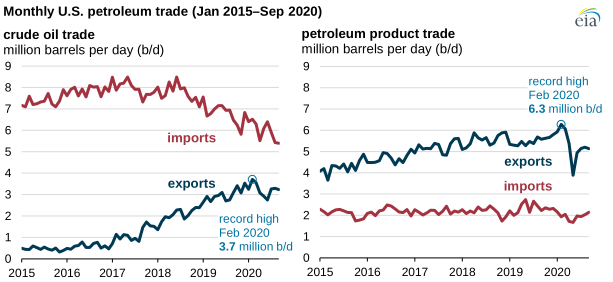
The decrease in global petroleum consumption led to a sharp decline in U.S. petroleum product exports. U.S. gross exports of petroleum products fell for three consecutive months, from a record high of 6.3 million b/d in February to 3.9 million b/d in May. This change in petroleum product exports was the main factor in the overall shift in U.S. petroleum trade from net exports to net imports in May and June. Since then, gross petroleum product exports increased to 5.1 million b/d in September, the most recent data in EIA’s Petroleum Supply Monthly.
U.S. gross exports of crude oil, which declined in May and June, increased to 3.2 million b/d for September (the most recent month for which data are available), a level less than the record high of 3.7 million b/d set in February 2020. Gross imports of crude oil, however, have resumed their long-term decline and most recently totaled 5.4 million b/d for September, the lowest monthly value since March 1992.
Principal contributor: Corrina Ricker