
Crude oil prices were generally lower in 2019 than in 2018
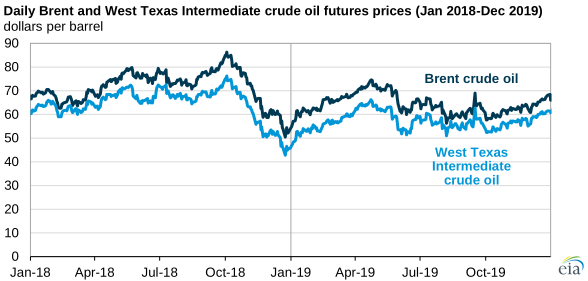
The price of Brent crude oil, the international benchmark, averaged $64 per barrel (b) in 2019, $7/b lower than its 2018 average. The price of West Texas Intermediate (WTI) crude oil, the U.S. benchmark, averaged $57/b in 2019, $7/b lower than in 2018.
Compared with recent years, both crude oil prices traded within relatively narrow price ranges throughout the year. Brent prices reached an annual daily low of $55/b in early January, rising to a daily high of $75/b in late April. The resulting range of $20/b is the narrowest since 2003. WTI prices ranged from $47/b to $66/b.
More recently, crude oil prices have increased following the January 3 U.S. military operation in Iraq, likely reflecting an increase in geopolitical risk.
Although the 2019 range of daily prices remained relatively narrow, Brent and WTI front-month futures prices did experience their largest single-day price increases since 2008. On Monday, September 16, 2019, the first full day of trading after an attack on key energy installations in Saudi Arabia, Brent and WTI crude oil prices increased by $9/b and $8/b, respectively. The price increases were relatively short lived, and prices returned to pre-attack levels by the end of the month because of Saudi Arabia’s ability to bring production back online within weeks of the attack and global concerns about demand growth.
Throughout 2019, increases in U.S. petroleum production put downward pressure on crude oil prices. In addition, the production increases likely limited the effect on prices from the attack on Saudi Arabia, production cut announcements from the Organization of the Petroleum Exporting Countries (OPEC), and U.S. sanctions on Iran and Venezuela that limited crude oil exports from those countries.
Outside the United States, crude oil production from major producers such as Saudi Arabia, Venezuela, and Iran declined in 2019. EIA expects that total OPEC crude oil production averaged 29.8 million b/d in 2019, a decline from the 2018 average of 32.0 million b/d. U.S. crude oil imports from OPEC countries were at their lowest level in several decades. To continue limiting excess crude oil supply, on December 7, 2019, OPEC+ (OPEC plus 10 other nations such as Russia, Mexico, and Kazakhstan) announced they were deepening the production cuts originally announced in December 2018.
Based on the U.S. Energy Information Administration’s (EIA) monthly data through October and short-term forecasts for November and December, 2019 will likely be a record year for several U.S. crude oil and petroleum metrics. EIA expects that U.S. crude oil and other liquids production will reach an annual average of 19.6 million barrels per day (b/d), the highest level on record. EIA also expects U.S. crude oil production will average 12.3 million b/d in 2019, making the United States the largest crude oil producer in the world.
In its December Short-Term Energy Outlook, EIA expects U.S. crude oil and petroleum product net imports will average 490,000 b/d in 2019, down from 2.3 million b/d in 2018. In September and October, the United States exported more petroleum (crude oil and products) than it imported for the first time on record, based on monthly values since 1973. EIA’s monthly data through December 2019 will be available by the end of February 2020.
Principal contributor: Matt French
Tags: prices, liquid fuels, crude oil, oil/petroleum