
EIA analysis explores India’s projected energy consumption
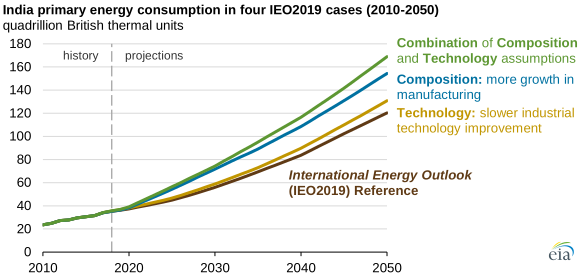
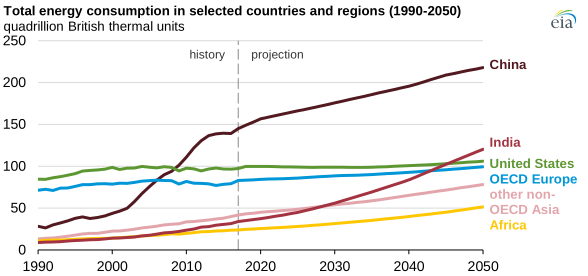
In the U.S. Energy Information Administration’s (EIA) International Energy Outlook 2019 (IEO2019), India has the fastest growing rate of energy consumption globally through 2050. By 2050, EIA projects in the IEO2019 Reference case that India will consume more energy than the United States by the mid-2040s, and its consumption will remain second only to China through 2050. EIA explored three alternative outcomes for India’s energy consumption in an Issue in Focus article released today and a corresponding webinar held at 9:00 a.m. Eastern Standard Time.
Long-term energy consumption projections in India are uncertain because of its rapid rate of change magnified by the size of its economy. The Issue in Focus article explores two aspects of uncertainty regarding India’s future energy consumption: economic composition by sector and industrial sector energy intensity. When these assumptions vary, it significantly increases estimates of future energy consumption.
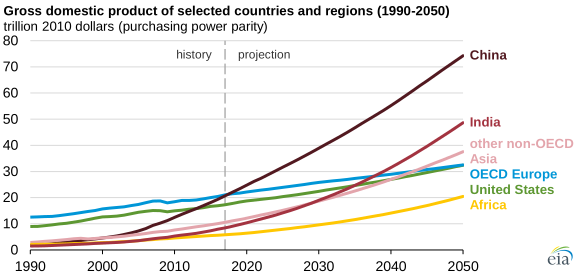
In the IEO2019 Reference case, EIA projects the economy of India to surpass the economies of the European countries that are part of the Organization for Economic Cooperation and Development (OECD) and the United States by the late 2030s to become the second-largest economy in the world, behind only China. In EIA’s analysis, gross domestic product values for countries and regions are expressed in purchasing power parity terms.
The IEO2019 Reference case shows India’s gross domestic product (GDP) growing from $9 trillion in 2018 to $49 trillion in 2050, an average growth rate of more than 5% per year, which is higher than the global average annual growth rate of 3% in the IEO2019 Reference case.
India’s economic growth will continue to drive India’s growing energy consumption. In the IEO2019 Reference case, India’s total energy consumption increases from 35 quadrillion British thermal units (Btu) in 2018 to 120 quadrillion Btu in 2050, growing from a 6% share of the world total to 13%. However, annually, the level of GDP in India has a lower energy consumption than some other countries and regions.
In the Issue in Focus, three alternative cases explore different assumptions that affect India’s projected energy consumption:
- Composition case: EIA assumes India’s economy shifts toward further growth in manufacturing, which increases energy consumption.
- Technology case: EIA assumes India’s industrial technology does not advance as quickly as in the IEO2019 Reference case, resulting in greater energy use.
- Combination case: EIA combines the assumptions in the Composition and Technology cases.
EIA’s analysis shows that the country's industrial activity has a greater effect on India’s energy consumption than technological improvements. In the IEO2019 Composition and Combination cases, where the assumption is that economic growth is more concentrated in manufacturing, energy use in India grows at a greater rate because those industries have higher energy intensities.
In the IEO2019 Combination case, India’s industrial energy consumption grows to 38 quadrillion Btu more in 2050 than in the Reference case. This difference is equal to a more than 4% increase in 2050 global energy use.
Principal contributors: Elizabeth Sendich, Ari Kahan