
Tax credit phaseout encourages more wind power plants to be added by end of year
Republished May 15, 2019 to clarify the timing of the production tax credit phaseout.
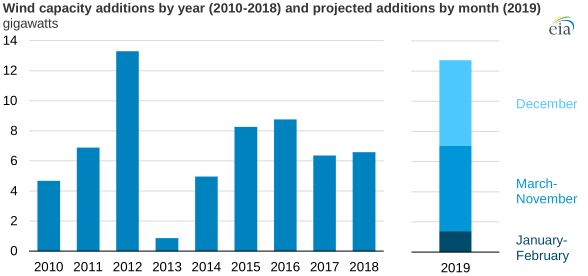
EIA expects that U.S. wind capacity additions in 2019 will total 12.7 gigawatts (GW), exceeding annual capacity additions for the previous six years but falling short of the record 13.3 GW of wind capacity added in 2012. Expected capacity additions discussed in this article are based on projects reported to EIA through surveys and reported in EIA’s Preliminary Monthly Electric Generator Inventory.
Changes in annual capacity additions for wind in the United States are often explained by changes to tax incentives. The U.S. production tax credit (PTC), which provides operators with a tax credit per kilowatthour of renewable electricity generation for the first 10 years a facility is in operation, was initially set to expire for all eligible technologies at the end of 2012 but was later retroactively renewed. The high level of annual capacity additions in 2012 was driven by developers scheduling project completion in time to qualify for the PTC. Similarly, the increase in annual capacity additions for wind scheduled for 2019 is largely being driven by the legislated phaseout of the PTC extension for wind.
When renewed in 2013, the PTC provided a maximum tax credit for wind generation of 2.3 cents per kilowatthour (kWh) for the first 10 years of production. Under the PTC phaseout, the amount of the tax credit decreases by 20 percentage points per year from 2017 through 2019. Facilities that begin construction after December 31, 2019, will not be able to claim the PTC.
Under the current PTC legislation, wind projects are eligible to receive credit based on either the year the project begins operation or the year in which they demonstrate that 5% of total capital cost for the project has been spent and project construction has begun. This 5% down method, known as safe harboring, enables wind developers to receive the PTC at a given year’s level, provided they complete construction no more than four calendar years after the calendar year that construction of the facility began.
U.S. wind project developers who want to receive the full 2016 value of the PTC must begin operations by the end of 2020. However, based on the latest project statuses reported on the Preliminary Monthly Electric Generator Inventory, more wind capacity is expected to come online by the end of 2019 than by the end of 2020. As in previous years, many of the annual wind capacity additions are expected to come online in the month of December. According to reported dates for wind projects coming online in 2019, 5.7 GW, or 44.7% of the annual total, are currently expected to be completed in December.
Principal contributor: Richard Bowers
Tags: generation, electricity, wind, power plants