
Space heating and water heating account for nearly two thirds of U.S. home energy use
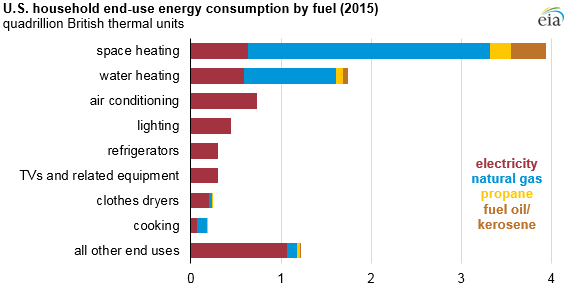
Space heating and water heating were the top two energy-consuming uses in U.S. homes in 2015, according to EIA’s latest Residential Energy Consumption Survey (RECS). Space heating consumption can vary considerably by climate and building characteristics, while variation in water heating consumption is driven primarily by the number of occupants in a home. Households use a variety of fuels for space heating and water heating, which affects these end-use shares of household energy expenditures.
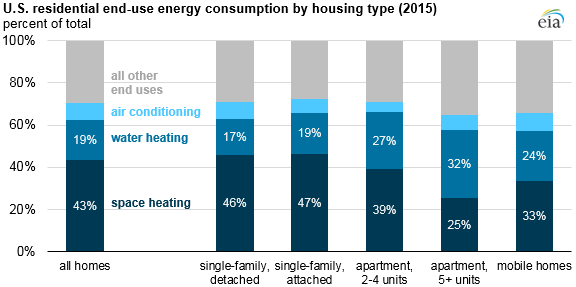
Household energy consumption varies considerably by the type of home construction. Single-family detached homes accounted for 62% of the occupied residential building stock in 2015, and residents in these homes consumed nearly three times more energy on average than residents living in an apartment building with five or more units. In single-family detached homes, space heating was by far the largest end use at 46% of total consumption. For residents of large apartment buildings, space heating accounted for only 25% of consumption.
Apartments are much smaller than single-family homes, averaging 924 square feet per apartment versus 2,486 square feet per single-family home. Adjacent apartments act as a form of insulation from weather elements, which reduces heating losses and overall heating loads relative to single-family homes. In large apartment buildings, space heating energy usage is often lower than water heating.
Note: Average values based only on the households using that end use.
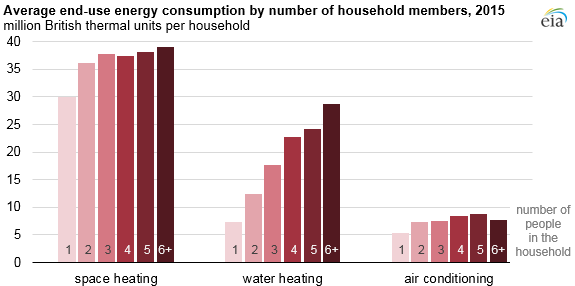
The number of household members is a key determinant of energy consumption in homes, particularly for water heating. In 2015, a two-person household consumed 12.5 million British thermal units (Btu) on average, or 16% of overall consumption, to heat water. A four-person household consumed nearly twice as much energy for water heating at 22.7 million Btu per home, or 24% of overall consumption for a household that size. By comparison, the number of occupants in a home has relatively less effect on the energy consumed for other end uses such as space heating or air conditioning.
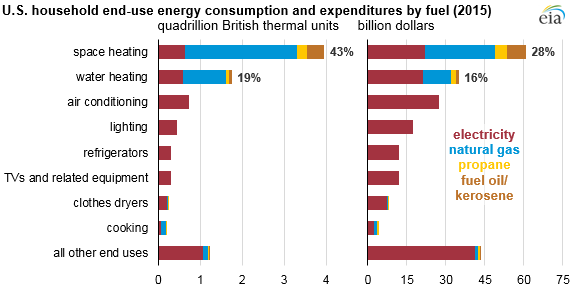
In energy equivalent units, households paid $37.55/million Btu for electricity compared with $10.31/million Btu for natural gas in 2015. Households use a mix of natural gas, electricity, and other fuels for space heating and water heating, but electricity is the dominant fuel for most of the remaining end uses such as air conditioning, refrigerators, and lighting.
Because of the mix of fuels used, expenditures for space heating and water heating tend to be lower relative to other household end uses. Space heating and water heating collectively accounted for 62% of household energy consumption in 2015, but they were only responsible for 44% of household energy costs because of the mix of fuels used to provide these end uses.
The 2015 RECS includes consumption and cost estimates for 26 electricity, 7 natural gas, 5 propane, and 3 fuel oil household energy end-use categories. These data, as well as total and average fuel estimates across household characteristics, are available in RECS tables, reports, and a microdata file. Detailed documentation, including descriptions of the end-use estimation process, is also available.
Principal contributor: Chip Berry