Menu
Crude oil, gasoline, heating oil, diesel, propane, and other liquids including biofuels and natural gas liquids.
Exploration and reserves, storage, imports and exports, production, prices, sales.
Sales, revenue and prices, power plants, fuel use, stocks, generation, trade, demand & emissions.
Energy use in homes, commercial buildings, manufacturing, and transportation.
Reserves, production, prices, employment and productivity, distribution, stocks, imports and exports.
Includes hydropower, solar, wind, geothermal, biomass and ethanol.
Uranium fuel, nuclear reactors, generation, spent fuel.
Comprehensive data summaries, comparisons, analysis, and projections integrated across all energy sources.
Monthly and yearly energy forecasts, analysis of energy topics, financial analysis, congressional reports.
Financial market analysis and financial data for major energy companies.
Greenhouse gas data, voluntary reporting, electric power plant emissions.
Maps, tools, and resources related to energy disruptions and infrastructure.
State energy information, including overviews, rankings, data, and analyses.
Maps by energy source and topic, includes forecast maps.
International energy information, including overviews, rankings, data, and analyses.
Regional energy information including dashboards, maps, data, and analyses.
Tools to customize searches, view specific data sets, study detailed documentation, and access time-series data.
EIA's free and open data available as API, Excel add-in, bulk files, and widgets
Come test out some of the products still in development and let us know what you think!
EIA's open source code, available on GitHub.
Forms EIA uses to collect energy data including descriptions, links to survey instructions, and additional information.
Sign up for email subscriptions to receive messages about specific EIA products
Subscribe to feeds for updates on EIA products including Today in Energy and What's New.
Short, timely articles with graphics on energy, facts, issues, and trends.
Lesson plans, science fair experiments, field trips, teacher guide, and career corner.
EIA is continuing normal publication schedules and data collection until further notice.
Fewer Northeast homeowners are choosing to lock in their heating oil prices this winter compared to previous years. About one-third of Northeast homeowners had heating oil supply contracts during the few years before the run-up in oil prices in 2008. Nearly half of homeowners then sought supply contracts during 2008 to protect against high fuel prices feared at the time. After petroleum prices collapsed during the second half of 2008, so did the percentage of homeowners with supply contracts the following two winters, with estimated participation sinking to about 25% in both 2009 and 2010. For this winter the number is expected to be even lower.
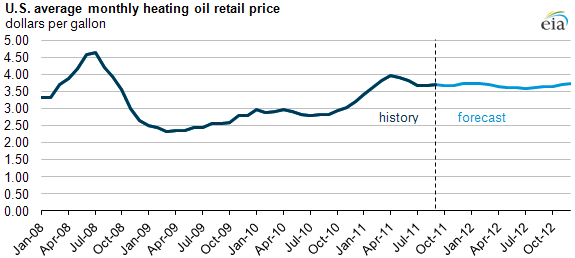
About 80% of U.S. households that use heating oil are located in the Northeast. The retail price for home heating oil in that area averaged $3.82 per gallon by the middle of October (the month that marks the start of the U.S. winter heating season in many areas where heating oil is used). This is up 27% from $3.00 per gallon a year earlier, according to EIA. EIA's Short-Term Energy and Winter Fuels Outlook expects the U.S. home heating oil price will average $3.71 per gallon for the season, up from $3.38 per gallon last winter.
Consumers can enter into a fixed-price or a price-cap contract with marketers and suppliers (dealers) to protect their budgets from being hit with high heating oil bills. A fixed-price contract allows a homeowner to pay the same price for heating oil throughout the winter, which is helpful when heating fuel costs rise, but a money-losing deal when prices fall below the locked-in price. With a price-cap contract, a limit is set on the maximum amount consumers will pay for heating oil no matter how high the price goes, but they will pay less when the price falls. Consumers have to pay an extra fee of 25 to 40 cents for each gallon of heating fuel to get flexible prices with a price-cap contract.
The number of homeowners who have entered into supply contracts is smaller than normal and may be at the lowest level in at least five years, according to heating oil associations representing dealers in several Northeast states.
Tags: distillate fuel, forecasts/projections, heating oil, liquid fuels, oil/petroleum, prices, STEO (Short-Term Energy Outlook)