Home > Forecast & Analysis > Short-Term Energy Outlook    
 
Short-Term Energy Outlook home page graphic Short-Term Energy Outlook
July 7, 2010 Release
(Next update August 10, 2010)
Adobe Acrobat PDF file graphic   Printer-friendly versions:
Full Report     Text Only     Tables Only     Charts Only

   Highlights

   |   

Global Crude Oil
and Liquid Fuels

   |   

U.S. Crude Oil
and Liquid Fuels

   |   

Natural Gas

   |   

Electricity

   |   

   Coal

   |   

Carbon Dioxide Emissions

Highlights

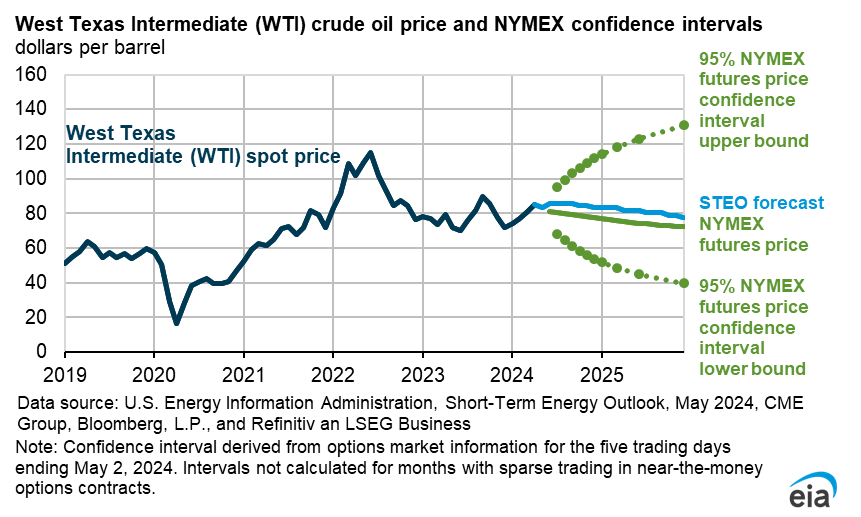
  • EIA projects that the West Texas Intermediate (WTI) spot price, which ended June near $76 per barrel, will average $79 per barrel over the second half of 2010 and $83 per barrel in 2011.  This forecast is unchanged from last month’s Outlook.

  • EIA expects that regular-grade motor gasoline retail prices will average $2.80 per gallon during this summer's driving season (the period between April 1 and September 30), up from $2.44 per gallon last summer.  The summer gasoline price forecast is up only slightly ($0.01) from last month’s Outlook, but $0.12 per gallon lower than we had forecast in April, when oil prices were significantly higher.

  • This Outlook includes EIA’s revised estimates of reductions in production resulting from the 6-month deepwater drilling moratorium announced by Secretary of the Interior Salazar on May 27.  The reductions in crude oil production resulting from the moratorium are estimated to average about 31,000 barrels per day (bbl/d) in the fourth quarter of 2010 (compared with an estimated 26,000 bbl/d in last month’s Outlook)and about 82,000 bbl/d in 2011 (up from 70,000 bbl/d).  EIA will continue to refine its estimated moratorium impacts as additional information becomes available.

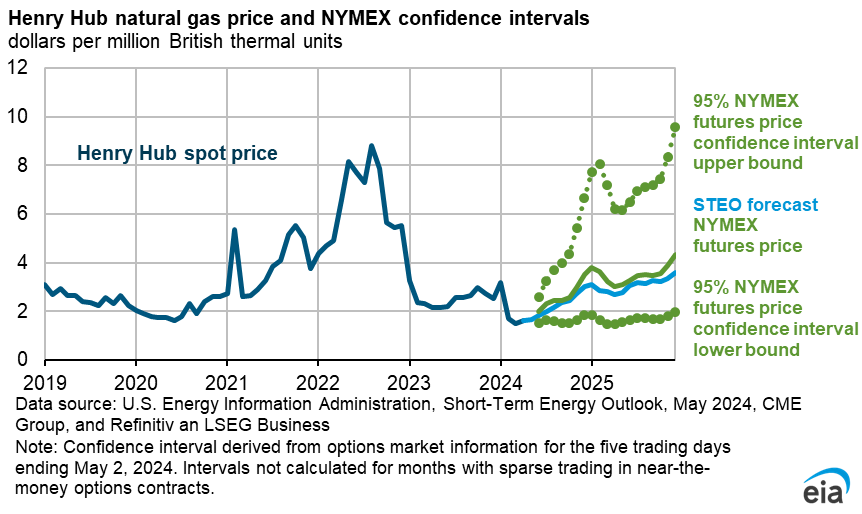
  • EIA expects the Henry Hub natural gas spot price to average $4.70 per million Btu (MMBtu) this year, a $0.75-per-MMBtu increase over the 2009 average and $0.22 per MMBtu higher than in last month’s Outlook.  Most of the increase in the price forecast occurs in the third quarter of this year, due to projections of increased hurricane activity in the Gulf of Mexico this season, which pushed spot prices higher.  EIA expects the Henry Hub spot price to average $5.17 per MMBtu in 2011, up $0.11 per MMBtu from last month's Outlook.

  • The annual average residential electricity price changes only moderately over the forecast period, averaging 11.6 cents per kilowatthour (kWh) in 2010, up slightly from 11.5 cents per kWh in 2009, and rising to 12 cents per kWh in 2011.

  • Estimated U.S. carbon dioxide (CO2) emissions from fossil fuels, which declined by 7.0 percent in 2009, are expected to increase by 3.2 percent and 1.6 percent in 2010 and 2011, respectively, as economic growth spurs higher energy consumption.

Global Crude Oil and Liquid Fuels

Crude Oil and Liquid Fuels Overview.  EIA’s view of the world oil market is largely unchanged from recent Outlooks.  EIA forecasts that world oil prices will rise slowly as an expected renewal of global economic growth leads to higher world oil demand and members of the Organization of the Petroleum Exporting Countries (OPEC) continue their support of prices near current levels.

Global Crude Oil and Liquid Fuels Consumption.  EIA projects world oil consumption to grow by about 1.5 million bbl/d in both 2010 and 2011, mostly unchanged from last month’s Outlook.  However, estimates for oil consumption in 2009 were revised upwards, with these changes carried through the forecast period. Consequently, the level of forecasted demand in 2010 and 2011 is higher than last month’s Outlook.  Countries outside of the Organization for Economic Cooperation and Development (OECD) represent nearly all of the expected growth in world oil consumption, led by China, Saudi Arabia, and Brazil (World Liquid Fuels Consumption Chart).

Non-OPEC Supply.  EIA has revised its forecast of non-OPEC supply upwards from the last Outlook, with non-OPEC supply now expected to increase by 0.6 million bbl/d in 2010 and decline by less than 0.1 million bbl/d in 2011.  The forecast for oil production in Mexico is more optimistic than last month.  Data for the first half of the year have been higher than expected, as recent decline rates at the Cantarell field have fallen and the country has boosted output from other offshore areas.  Nonetheless, oil production in Mexico is still expected to fall by 0.1 million bbl/d in 2010 and roughly 0.2 million bbl/d in 2011.  Over the forecast period, Brazil, the United States, and Azerbaijan should provide the largest sources of non-OPEC supply growth.

OPEC Supply.  The 12 members of OPEC produced an estimated 29.4 million bbl/d of crude oil in the second quarter of 2010.  After remaining relatively steady for the past four quarters, EIA expects OPEC crude oil production to rise slightly through 2011 to accommodate increasing world oil consumption and maintain the organization’s market objectives.  Even with the increase in crude oil production, OPEC surplus capacity should remain over 5 million bbl/d in 2010 and 2011, versus 4.3 million bbl/d in 2009 and 1.5 million bbl/d in 2008 (OPEC Surplus Crude Oil Production Capacity Chart).  OPEC production of non-crude petroleum liquids, which are not subject to OPEC production targets, are expected to increase by 0.6 million bbl/d in 2010 and 0.7 million bbl/d in 2011.

OECD Petroleum Inventories.  Commercial oil inventories held in the OECD stood at about 2.7 billion barrels at the end of the first quarter of 2010, equivalent to about 57 days of forward cover, and roughly 67 million barrels more than the 5-year average for the corresponding time of year (Days of Supply of OECD Commercial Stocks Chart).  The level of OECD oil inventories is expected to decline through the forecast period, though days-forward-cover should remain high due to falling OECD oil consumption.

Crude Oil Prices.  WTI crude oil spot prices averaged $75.34 per barrel in June 2010 ($1.60 per barrel above the prior month’s average), close to the $76 per barrel projected in the forecast in last month’s Outlook.  EIA projects WTI prices will average about $79 per barrel over the second half of this year and rise to $84 by the end of next year (West Texas Intermediate Crude Oil Price Chart).

Energy price forecasts are highly uncertain, as history has shown (Energy Price Volatility and Forecast Uncertainty).  WTI futures for September 2010 delivery for the 5-day period ending July 1 averaged $77 per barrel, and implied volatility averaged 35 percent.  This made the lower and upper limits of the 95-percent confidence interval $60 and $98 per barrel, respectively.

Last year at this time, WTI for September 2009 delivery averaged $70 per barrel, and implied volatility averaged 44 percent, rendering the limits of the 95-percent confidence interval $52 and $95 per barrel.

U.S. Crude Oil and Liquid Fuels

U.S. Liquid Fuels Consumption.  U.S. liquid fuels consumption is beginning to show signs of recovery after having fallen by 810,000 bbl/d in 2009, the fourth consecutive annual decline (U.S. Liquid Fuels Consumption Growth Chart).  The year-over-year decline in total liquid fuels consumption slowed to 20,000 bbl/d in the first quarter of 2010.  Total consumption for the second quarter, however, rose by 500,000 bbl/d compared with the same period last year.  For the year as a whole, projected total liquid fuels consumption grows by 200,000 bbl/d in 2010 and by 170,000 bbl/d in 2011 as all of the major petroleum products register consumption growth in each of those years.

U.S. Liquid Fuels Supply and Imports.  Projected domestic crude oil production increases by 75,000 bbl/d in 2010 (U.S. Crude Oil Production Chart).  Based on the forecast of a more active hurricane season by the National Oceanic and Atmospheric Administration (NOAA), EIA estimates a median outcome of 26 million barrels of total shut-in crude oil production because of tropical storm activity in the Gulf of Mexico this year (see 2010 Outlook for Hurricane-Related Production Outages in the Gulf of Mexico).

Reversing a pattern of increases over several years, forecast crude oil production in 2011 falls by 26,000 bbl/d to 5.37 million bbl/d.  The lower production forecast includes EIA's estimates of reductions in the output of crude oil from the deepwater Gulf of Mexico of 31,000 bbl/d in the fourth quarter of 2010 and 82,000 bbl/d in 2011 because of the recently imposed 6-month drilling moratorium. The reductions in crude oil production increase from a monthly average of about 10,000 bbl/d in September 2010 to nearly 100,000 bbl/d by December 2011.

Projected ethanol production, which averaged 700,000 bbl/d in 2009, increases to an average of 850,000 bbl/d in 2010 and 880,000 bbl/d in 2011.  EIA forecasts that liquid fuel net imports (including both crude oil and refined products), which declined by 1.4 million bbl/d in 2009, will fall by a further 110,000 bbl/d in 2010.   In 2011, projected total liquid fuel net imports increase by 80,000 bbl/d.

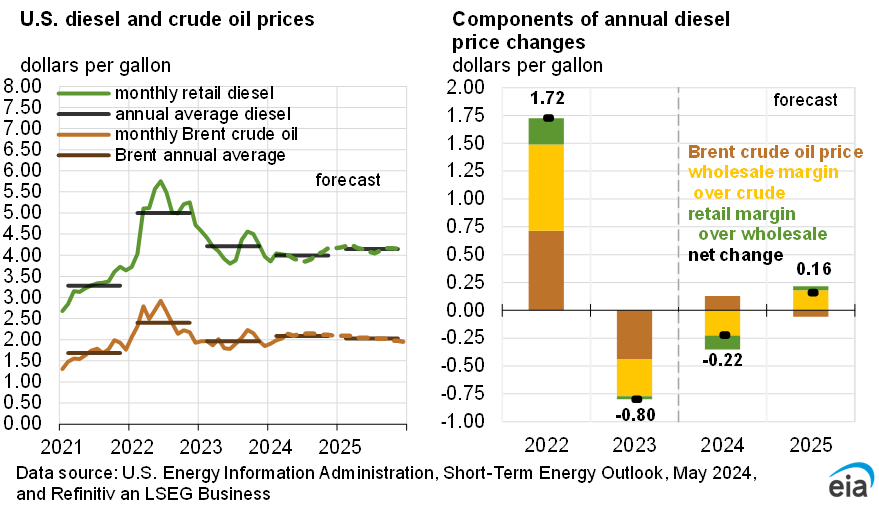
U.S. Petroleum Product Prices.  Projected regular-grade gasoline retail prices rise from an average $2.35 per gallon in 2009 to an average $2.77 per gallon in 2010 and $2.90 per gallon in 2011.  Forecast regular-grade pump prices average $2.80 per gallon this summer, an increase of 36 cents from the previous summer.  On-highway diesel fuel retail prices, which averaged $2.46 per gallon in 2009, average $2.98 per gallon in 2010 and $3.13 in 2011 in this forecast.

Natural Gas

U.S. Natural Gas Consumption.  EIA projects total natural gas consumption will average 64.7 billion cubic feet per day (Bcf/d) and 64.8 Bcf/d in 2010 and 2011, respectively (Total U.S. Natural Gas Consumption Growth Chart ).  Estimated year-over-year consumption growth averaged 2.8 Bcf/d (4.3 percent) in the first half of 2010, with significant increases in the electric power and industrial sectors.  This growth is expected to continue at a slower pace in the second half of the year with an increase of 1.5 Bcf/d (2.6 percent).  EIA’s projected natural-gas-weighted industrial production index (a measure of industrial activity in natural-gas-intensive industries) increases by 7.5 percent in 2010, leading to a 1.0 Bcf/d (5.9-percent) increase in natural gas consumption in the industrial sector.

Projected natural gas consumption is virtually flat in 2011.  The projected 2.7 percent increase in the natural-gas-weighted industrial production index and NOAA forecast of slightly colder weather next year (1.4 percent increase in heating degree-days) contribute to consumption growth in the residential, commercial, and industrial sectors in 2011.  However, this growth is offset by a decline in natural gas consumption in the electric power sector because of the forecast increase in natural gas prices relative to coal prices next year.

U.S. Natural Gas Production and Imports.  EIA expects total marketed natural gas production of 61.3 Bcf/d in 2010, an increase of 1.3 Bcf/d over 2009 levels.  EIA projects a continuing decline in Gulf of Mexico production, which is offset by gains in onshore production.  Forecast marketed production declines by 0.4 Bcf/d to 60.9 Bcf/d in 2011.

Federal Gulf of Mexico natural gas production falls by about 10 percent in both 2010 and 2011 as a result of hurricane outages, the announced offshore drilling moratorium, and the decline in active drilling rigs over the last 4 years. The estimated median outcome for hurricane outages from June through November is a cumulative 166 Bcf this year, compared with 19 Bcf in 2009 (2010 Outlook for Hurricane-Related Production Outages in the Gulf of Mexico).  The offshore drilling moratorium is projected to reduce Gulf of Mexico production by an average of 0.05 Bcf/d for the last 6 months of 2010 and 0.25 Bcf/d for 2011.

Projected lower-48 onshore production increases by 2 Bcf/d (3.8 percent) in 2010 and 0.2 Bcf/d (0.3 percent) in 2011.  According to Baker-Hughes, natural gas rig counts have climbed from under 670 in July 2009 to about 950 in April this year and have remained relatively stable since then.

Forecasted imports of liquefied natural gas (LNG) average 1.37 Bcf/d in 2010, a downward revision of about 0.14 Bcf/d from last month.  Projected imports increase to 1.52 Bcf/d in 2011. While imports are expected to grow, higher prices in European and Asian markets will likely divert LNG cargoes from the United States. EIA also forecasts gross pipeline imports of 8.8 Bcf/d in 2010, a decrease of about 2.9 percent from 2009. EIA expects gross pipeline imports of 8.2 Bcf/d in 2011.

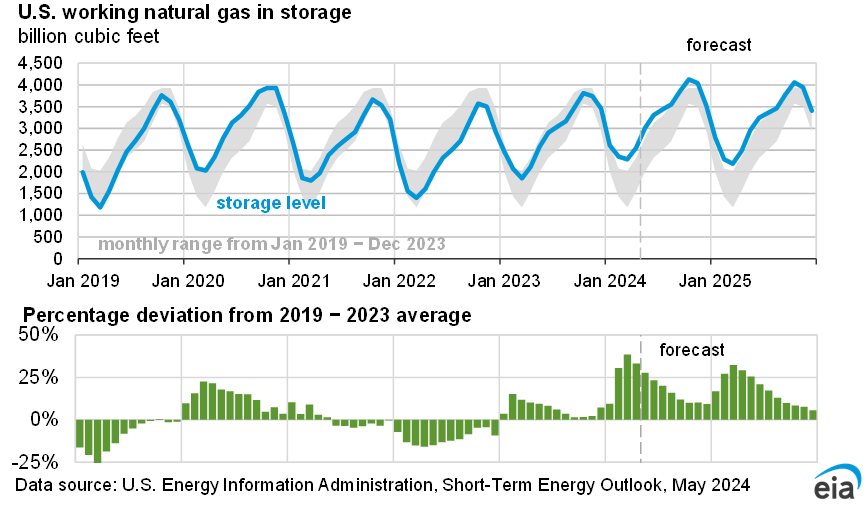
U.S. Natural Gas Inventories.  On June 25, 2010, working natural gas in storage was 2,684 Bcf (U.S. Working Natural Gas in Storage Chart). This is 27 Bcf below last year’s level and 287 Bcf higher than the 5-year (2005-2009) average.  EIA expects working gas inventories this year to remain very near last year’s levels, reaching 3,810 Bcf at the end of October 2010.

U.S. Natural Gas Prices.  The Henry Hub spot price averaged $4.80 per MMBtu in June, $0.66 per MMBtu higher than the average spot price in May (Henry Hub Natural Gas Price Chart).  The forecast price for the second half of 2010 averages $4.68 per MM Btu, $0.32 per MMBtu higher than last month’s Outlook.  The risk of hurricane outages and the projected reduction in drilling activity combine to strengthen prices through the year. A small decline in U.S. production alongside increased consumption  leads to higher prices in 2011; the projected Henry Hub spot price averages $5.17 per MMBtu.

Uncertainty over future natural gas prices is lower this year compared with last year at this time.  Natural gas futures for September 2010 delivery for the 5-day period ending July 1 averaged $4.77 per MMBtu, and the average implied volatility over the same period was 53 percent.  This produced lower and upper bounds for the 95-percent confidence interval of $3.16 and $7.18 per MMBtu, respectively.  At this time last year the natural gas September 2009 futures contract averaged $4.00 per MMBtu and implied volatility averaged almost 76 percent.  This rendered the lower and upper limits of the 95-percent confidence interval at $2.25 and $7.14 per MMBtu.

Electricity

U.S. Electricity Consumption.  This summer has started out much warmer than last summer, resulting in more demand for air conditioning.  Cooling degree-days during June were 28 percent higher than in June 2009 (U.S. Summer Cooling Degree Days).  EIA estimates the total consumption of electricity across all sectors during the first half of this year increased by 3.8 percent from the first half of 2009.  Consumption is expected to show similar year-over-year growth of 3.5 percent during the second half of 2010.  Growth in electricity consumption should return to a more typical rate of 1.1 percent in 2011 (U.S. Total Electricity Consumption Chart).

U.S. Electric Power Sector Generation.  Snowmelt runoff projections earlier this spring pointed to low levels of hydropower generation during the summer.  However, heavy rainfall in the Pacific Northwest during May and June has pushed generation by hydroelectric plants much higher than normal.  An increase in EIA’s expectation for overall electricity consumption offsets higher expected natural gas fuel costs, keeping growth in natural gas generation at 5.6 percent during 2010, unchanged from last month’s Outlook.  The level of natural gas generation is expected to stay relatively flat in 2011.

U.S. Electricity Retail Prices.  EIA estimates that residential retail electricity prices during the first half of 2010 were about the same as in the first half of 2009.  However, rising fuel costs for natural gas and coal generation are likely to push up retail prices later this year, causing prices over the entire year to grow by about 0.8 percent.  Increased fuel costs should push residential prices higher by about 2.7 percent during 2011 (U.S. Residential Electricity Prices Chart).

Coal

U.S. Coal Consumption.  EIA projects that coal consumption in the electric power sector will increase by 4.6 percent in 2010.  Continued electricity demand growth in 2011 combined with minimal growth in nuclear and natural-gas-fired generation results in an additional 2.4-percent increase in electric-power-sector coal consumption next year (U.S. Coal Consumption Growth Chart).

U.S. Coal Supply.  Projected coal production falls by 0.4 percent in 2010 despite increases in domestic consumption and lower imports.  The balance between supply and consumption is satisfied through significant reductions in both producer (14 percent) and end-user (11 percent) inventories (U.S. Electric Power Sector Coal Stocks Chart).  EIA projects a 3.6-percent increase in coal production in 2011 to meet continued growth in coal consumption (U.S. Annual Coal Production Chart).

U.S. Coal Trade.  U.S. coal imports and exports fell by 34 percent and 28 percent in 2009, respectively.  EIA projects imports to decline another 15 percent in 2010 as increased domestic consumption is met by draws on U.S. coal inventories.  Forecast coal exports, on the other hand, grow by 25 percent in 2010, driven in part by rising demand for metallurgical coal in China and other Southeast Asian countries.  Metallurgical coal is an essential component of the steelmaking process, and currently constitutes a larger share of the U.S. coal export market than steam coal (burned in thermal electric power plants).  From January through April 2010, the United States exported 19.6 million tons of metallurgical coal, 95 percent higher than the comparable period in 2009.

Projected coal imports grow by 35 percent in 2011, but the annual tonnage (26 million short tons) remains significantly below the 2005-through-2008 average of 34 million short tons.  Forecast coal exports in 2011 are relatively unchanged from 2010 levels.

U.S. Coal Prices. EIA estimates that the 2009 delivered electric-power-sector coal price increased by about 7 percent despite decreases in spot coal prices, lower prices for other fossil fuels, and declines in coal-fired electricity generation.  This higher cost of delivered coal reflects the impacts of longer-term power-sector coal contracts initiated during a period of high prices and rising transportation costs.  The projected electric-power-sector delivered coal price increases slightly (by 1.4 percent) to average $2.24 per MMBtu in 2010, and then declines to an average of $2.19 per MMBtu in 2011.

Carbon Dioxide Emissions

Forecast economic growth combined with increased use of coal and natural gas in the electric power sector contribute to increases in fossil-fuel CO2 emissions of 3.2 percent  in 2010 (U.S. Carbon Dioxide Emissions Growth Chart).  Increased demand for petroleum in the transportation sector (motor gasoline, diesel fuel and jet fuel), combined with continued electric-power-sector coal demand growth, contribute to the projected 1.6-percent increase in fossil-fuel CO2 emissions in 2011.  However, even with increases in 2010 and 2011, projected CO2   emissions are lower than annual emissions were from 1999 through 2008.


Price Summary

  Year Percent Change
 2008   2009   2010   2011  08-09 09-10 10-11
WTI Crudea ($/barrel) 99.57 61.66 78.69 82.50 -38.1 27.6 4.8
Gasolineb ($/gal)  3.26 2.35 2.77 2.90 -27.9 17.9 4.7
Dieselc ($/gal) 3.80 2.46 2.98 3.13 -35.1 21.1 5.0
Heating Oild ($/gal) 3.38 2.52 2.93 3.10 -25.4 16.4 5.6
Natural Gasd ($/mcf) 13.89 11.97 11.59 12.56 -13.8 -3.2 8.4
Electricityd (cents/kwh) 11.26 11.55 11.64 11.96 2.5 0.8 2.7
a West Texas Intermediate.   b Average regular pump price.
c On-highway retail.               d U.S. Residential average. 
 
Standard
Tables
 Icon for displaying a dynamic table - "Dynamic" table (HTML)
 Icon for displaying a printer-friendly table - printer-friendly table (PDF)

 All Tables in a single Excel file
  HTML PDF

Table SF01. U.S. Motor Gasoline Summer Outlook

PDF for Table SF01. U.S. Motor Gasoline Summer Outlook
1. U.S. Energy Market Summary Dynamic Table 1 U.S. Energy Market Summary PDF for Table 1 U.S. Energy Market Summary
2. U. S. Energy Prices Dynamic Table 2 U.S. Energy Prices PDF for Table 2 U.S. Energy Prices
3a. International Crude Oil and Liquid Fuels Supply, Consumption, and Inventories Dynamic Table 3a. International Crude Oil and Liquid Fuels Supply, Consumption, and Inventories PDF for Table 3a. International Crude Oil and Liquid Fuels Supply, Consumption, and Inventories
3b. Non-OPEC Crude Oil and Liquid Fuels Supply Dynamic Table 3b. Non-OPEC Crude Oil and Liquid Fuels Supply PDF for Table 3b. Non-OPEC Crude Oil and Liquid Fuels Supply
3c. OPEC Crude Oil and Liquid Fuels Supply Dynamic Table 3c. OPEC Crude Oil and Liquid Fuels Supply PDF for Table 3c. OPEC Crude Oil and Liquid Fuels Supply
3d. World Liquid Fuels Consumption Dynamic Table 3d. World Liquid Fuels Consumption PDF for Table 3d. World Liquid Fuels Consumption
4a. U.S. Crude Oil and Liquid Fuels Supply, Consumption, and Inventories Dynamic Table 4a. U.S. Crude Oil and Liquid Fuels Supply, Consumption, and Inventories PDF for Table 4a. U.S. Crude Oil and Liquid Fuels Supply, Consumption, and Inventories
4b. U.S. Petroleum Refinery Balance Dynamic Table 4b. U.S. Petroleum Refinery Balance PDF for Table 4b. U.S. Petroleum Refinery Balance
4c. U.S. Regional Motor Gasoline Prices and Inventories Dynamic Table 4c. U.S. Regional Motor Gasoline Prices and Inventories PDF for Table 4c. U.S. Regional Motor Gasoline Prices and Inventories
4d. U.S. Regional Heating Oil Prices and Inventories Dynamic Table 4d. U.S. Regional Heating Oil Prices and Inventories PDF for Table 4d. U.S. Regional Heating Oil Prices and Inventories
4e. U.S. Regional Propane Prices and Inventories Dynamic Table 4e. U.S. Regional Propane Prices and Inventories PDF for Table 4e. U.S. Regional Propane Prices and Inventories
5a. U.S. Natural Gas Supply, Consumption, and Inventories Dynamic Table 5a. U.S. Natural Gas Supply, Consumption, and Inventories PDF for Table 5a. U.S. Natural Gas Supply, Consumption, and Inventories
5b. U.S. Regional Natural Gas Consumption Dynamic Table 5b. U.S. Regional Natural Gas Consumption PDF for Table 5b. U.S. Regional Natural Gas Consumption
5c. U.S. Regional Natural Gas Prices Dynamic Table 5c. U.S. Regional Natural Gas Prices PDF for Table 5c. U.S. Regional Natural Gas Prices
6. U.S. Coal Supply, Consumption, and Inventories Dynamic Table 6. U.S. Coal Supply, Consumption, and Inventories PDF for Table 6. U.S. Coal Supply, Consumption, and Inventories
7a. U.S. Electricity Overview Dynamic Table 7a. U.S. Electricity Overview PDF for Table 7a. U.S. Electricity Overview
7b. U.S. Regional Electricity Retail Sales Dynamic Table 7b. U.S. Regional Electricity Retail Sales PDF for Table 7b. U.S. Regional Electricity Retail Sales
7c. U.S. Regional Electricity Prices Dynamic Table 7c. U.S. Regional Electricity Prices PDF for Table 7c. U.S. Regional Electricity Prices
7d. U.S. Electricity Generation by Fuel and Sector Dynamic Table 7d. U.S. Electricity Generation by Fuel and Sector PDF for Table 7d. U.S. Electricity Generation by Fuel and Sector
7e. U.S. Fuel Consumption for Electricity Generation by Sector Dynamic Table 7e. U.S. Fuel Consumption for Electricity Generation by Sector PDF for Table 7e. U.S. Fuel Consumption for Electricity Generation by Sector
8. U.S. Renewable Energy Supply and Consumption Dynamic Table 8. U.S. Renewable Energy Supply and Consumption PDF for Table 8. U.S. Renewable Energy Supply and Consumption
9a. U.S. Macroeconomic Indicators and CO2 Emissions Dynamic Table 9a. U.S. Macroeconomic Indicators and CO<sub>2</sub> Emissions PDF for Table 9a. U.S. Macroeconomic Indicators and CO<sub>2</sub> Emissions
9b. U.S. Regional Macroeconomic Data Dynamic Table 9b. U.S. Regional Macroeconomic Data PDF for Table 9b. U.S. Regional Macroeconomic Data
9c. U.S. Regional Weather Data Dynamic Table 9c. U.S. Regional Weather Data PDF for Table 9c. U.S. Regional Weather Data
 
Figures       Icon for displaying chart as GIF file - chart only (GIF)
 Icon for displaying chart and data in an Excel file - chart and data in an Excel spreadsheet

 All figures and data in a single Excel file
  GIF Excel

1. West Texas Intermediate (WTI) Crude Oil Price

Image of Figure 1. West Texas Intermediate (WTI) Crude Oil Prices

Excel Spreadsheet for Figure 1. West Texas Intermediate (WTI) Crude Oil Prices

2. U.S. Gasoline and Crude Oil Prices

Image of Figure 2. Gasoline and Crude Oil Prices

Excel Spreadsheet for Figure 2. Gasoline and Crude Oil Prices

3. U.S. Diesel Fuel and Crude Oil Prices

Image of Figure 3. U.S. Diesel Fuel and Crude Oil Prices

Excel Spreadsheet for Figure 3. U.S. Diesel Fuel and Crude Oil Prices

4. Henry Hub Natural Gas Price

Image of Figure 4. Henry Hub Natural Gas Prices

Excel Spreadsheet for Figure 4. Henry Hub Natural Gas Prices

5. Natural Gas Prices

Image of Figure 5. Natural Gas Prices

Excel Spreadsheet for Figure 5. Natural Gas Prices

6. World Liquid Fuels Consumption

Image of Figure 6. World Liquid Fuels Consumption

Excel Spreadsheet for Figure 6. World Liquid Fuels Consumption

7. World Liquid Fuels Consumption Growth

Image of Figure 7. World Liquid Fuels Consumption Growth

Excel Spreadsheet for Figure 7. World Liquid Fuels Consumption Growth

8. World Crude Oil and Liquid Fuels Production Growth

Image of Figure 8. World Crude Oil and Liquid Fuels Production Growth

Excel Spreadsheet for Figure 8. World Crude Oil and Liquid Fuels Production Growth

9. Non-OPEC Crude Oil and Liquid Fuels Production Growth

Image of Figure 9. Non-OPEC Crude Oil and Liquid Fuels Production Growth

Excel Spreadsheet for Figure 9. Non-OPEC Crude Oil and Liquid Fuels Production Growth

10.Wold Consumption and Non-OPEC Production

Image of Figure 10. World Consumption and Non-OPEC Production

Excel Spreadsheet for Figure 10. World Consumption and Non-OPEC Production

11. OPEC Surplus Crude Oil Production Capacity

Image of Figure 11. OPEC Surplus Crude Oil Production Capacity

Excel Spreadsheet for Figure 11. OPEC Surplus Crude Oil Production Capacity

12. Days of Supply of OECD Commercial Oil Stocks

Image of Figure 12. Days of Supply of OECD Commercial Oil Stocks

Excel Spreadsheet for Figure 12. Days of Supply of OECD Commercial Oil Stocks

13. U.S. Crude Oil Production

Image of Figure 13. U.S. Crude Oil Production

Excel Spreadsheet for Figure 13. U.S. Crude Oil Production

14. U.S. Crude Oil Stocks

Image of Figure 14. U.S. Crude Oil Stocks

Excel Spreadsheet for Figure 14. U.S. Crude Oil Stocks

15 U.S. Liquid Fuels Consumption Growth

Image of Figure 15. U.S. Liquid Fuels Consumption Growth

Excel Spreadsheet for Figure 15. U.S. Liquid Fuels Consumption Growth

16. U.S. Gasoline and Distillate Inventories

Image of Figure 16. U.S. Gasoline and Distillate Inventories

Excel Spreadsheet for Figure 16. U.S. Gasoline and Distillate Inventories

17. U.S. Total Natural Gas Consumption

Image of Figure 17. U.S. Total Natural Gas Consumption

Excel Spreadsheet for Figure 17. U.S. Total Natural Gas Consumption

18. U.S. Working Natural Gas in Storage

Image of Figure 18. U.S. Working Natural Gas in Storage

Excel Spreadsheet for Figure 18. U.S. Working Natural Gas in Storage

19. U.S. Coal Consumption Growth

Image of Figure 19. U.S. Coal Consumption Growth

Excel Spreadsheet for Figure 19. U.S. Coal Consumption Growth

20. U.S. Annual Coal Production

Image of Figure 20. U.S. Annual Coal Production

Excel Spreadsheet for Figure 20. U.S. Annual Coal Production

21. U.S. Electric Power Sector Coal Stocks

Image of Figure 21. U.S. Electric Power Sector Coal Stocks

Excel Spreadsheet for Figure 21. U.S. Electric Power Sector Coal Stocks

22. U.S. Total Electricity Consumption

Image of Figure 22. U.S. Total Electricity Consumption

Excel Spreadsheet for Figure 22. U.S. Total Electricity Consumption

23. U.S. Residential Electricity Price

Image of Figure 23. U.S. Residential Electricity Price

Excel Spreadsheet for Figure 23. U.S. Residential Electricity Price

24. U.S. Annual Energy Expenditures

Image of Figure 24. U.S. Annual Energy Expenditures

Excel Spreadsheet for Figure 24. U.S. Annual Energy Expenditures

25. U.S. Carbon Dioxide Emissions Growth

Image of Figure 25.  U.S. Carbon Dioxide Emissions Growth

Excel Spreadsheet for Figure 25. U.S. Carbon Dioxide Emissions Growth

26. U.S. Summer Cooling Degree Days

Image of Figure 26. U.S. Summer Cooling Degree Days

Excel Spreadsheet for Figure 26. U.S. Summer Cooling Degree Days

27. U.S. Winter Heating Degree Days

Image of Figure 27. U.S. Winter Heating Degree Days

Excel Spreadsheet for Figure 27. U.S. Winter Heating Degree Days

28. U.S. Census Regions and Census Divisions

Image of Figure 28. U.S. Census Regions and Census Divisions

Excel Spreadsheet for Figure 28. U.S. Census Regions and Census Divisions

Sign up for email notices to be automatically notified when a new Short-Term Energy Outlook becomes available for on-line viewing.