
East Coast distillate fuel oil inventories higher than in recent years
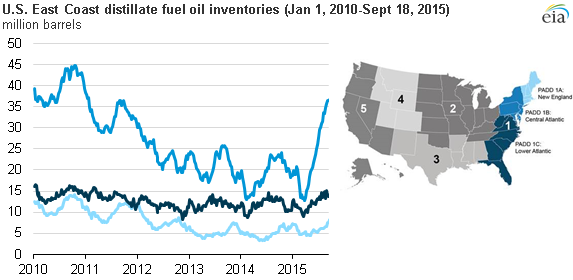
Inventories of distillate fuel oil in the U.S. East Coast are higher now than they have been in the previous three years, reaching 59 million barrels on September 18. Most of the recent increase is in the Central Atlantic region, but inventories are also higher in New England and in the Lower Atlantic, compared with previous late-September levels.
Heating oil, a type of distillate fuel oil, is used as a space heating or water heating fuel in about eight million U.S. households, almost all of which are in the Northeast. In the Northeast, 27% of households use heating oil for space heating, while nationwide only 6% of households use heating oil, based on data from EIA's latest Residential Energy Consumption Survey.
The East Coast region (Petroleum Administration for Defense District, or PADD 1) generally holds about 30% to 50% of the nation's distillate fuel oil inventory. These inventory levels fluctuate seasonally, typically drawing down in winter months and building up in summer months.
In the past three years, East Coast inventories had been relatively low compared to the previous five-year average, reflecting a long-term decline in heating oil demand and the increasing availability of imported supply from the global market. Recently, the combination of increased shipments from the Gulf Coast, higher refinery runs, and imports have boosted East Coast distillate inventories to 5.4 million barrels above the five-year average for the week ending September 11, the highest since 2011.
Before last winter, five other states joined New York in implementing stricter sulfur limits on home heating oil, contributing further to changes in the type of distillate fuel oil held in Northeast inventories. Historically, distillate fuel oil with a sulfur content greater than 500 parts per million (ppm) made up 60%–70% of inventories in the Central Atlantic region (PADD 1B).
As stricter sulfur limits were enacted and the New York Mercantile Exchange (Nymex) changed to a lower sulfur specification contract, the sulfur content of inventories also declined. Currently 80% of PADD 1B inventories have a sulfur content of 15 ppm or lower.
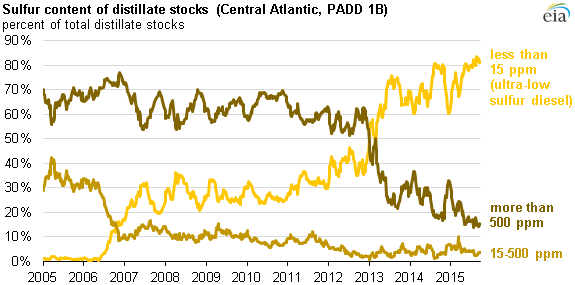
Note: Ppm denotes parts per million.
In addition, new regulations that limit marine fuel sulfur levels in certain coastal waters to 1,000 ppm began in January 2015. To comply, marine vessels are switching to lower-sulfur distillate fuel, installing emissions controls and other options, but the effect on distillate fuel demand is relatively small.
Beginning October 7, EIA will resume its seasonal Heating Oil and Propane Update report of retail and wholesale heating oil prices. Last year, the data collection was expanded to include heating oil data for 22 states.
Principal contributor: T. Mason Hamilton