
Under sanctions, Iran’s crude oil exports have nearly halved in three years
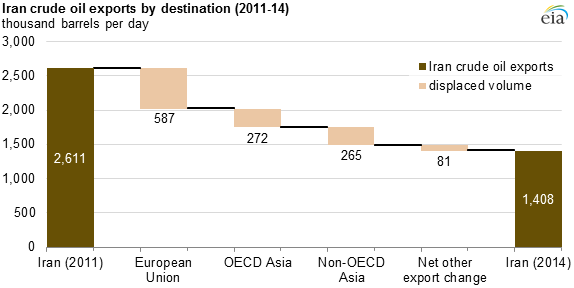
Note: Values may not add to the total because of independent rounding.
Note: OECD is the Organization for Economic Cooperation and Development.
In early April this year, Iran and the five permanent members of the United Nations Security Council plus Germany (P5+1) reached a framework agreement to guide negotiations targeting a comprehensive agreement by June 30. The comprehensive agreement could result in the lifting of crude oil-related sanctions against Iran, which in turn could result in an increase in Iran's crude oil production and exports. However, the ultimate decision and the timing that sanctions could be lifted are highly uncertain.
Sanctions imposed by the United States and the European Union (EU) at the end of 2011 and during the summer of 2012, respectively, led to the displacement of more than 1.0 million barrels per day (b/d) of Iranian crude oil on the global market. Iran's main buyers in Asia, Europe, and elsewhere have replaced Iranian crude oil with barrels from other members of the Organization of the Petroleum Exporting Countries (OPEC). If oil-related sanctions are lifted, Iran will look to regain export market share, competing with other OPEC members with similar crude oil grades.
Iranian crude oil and lease condensate purchases. Iran's crude oil and condensate exports averaged 1.4 million b/d in 2014. In 2011, prior to sanctions, Iran exported 2.6 million b/d, most of which went to Asia, particularly China (550,000 b/d), India (320,000 b/d), Japan (315,000 b/d), and South Korea (250,000 b/d).
The EU was the second-largest regional buyer of Iranian oil in 2011, purchasing nearly 600,000 b/d of crude oil and condensate. Turkey (185,000 b/d), South Africa (75,000 b/d), and the United Arab Emirates (95,000 b/d) were also significant buyers.
In 2012, as the United States and the EU imposed sanctions, almost all of Iran's buyers either reduced their purchases or halted them. By 2013, Iran's crude oil and condensate exports dropped to just below 1.3 million b/d, with the main importers being China, India, Japan, South Korea, Turkey, UAE, and Syria. Iran's exports grew by almost 150,000 b/d in 2014, reflecting increased imports by China and India.
Displacement of Iranian oil. Iranian light and heavy crude oils are the country's two main crude oil export grades. Countries that reduced or halted imports from Iran replaced those barrels with similar quality crude grades from Saudi Arabia, Kuwait, Nigeria, Angola, and Iraq. Asian countries, which were mostly purchasing Iranian heavy crude oil, increased their purchases of similar crude grades from Saudi Arabia and Kuwait after 2011.
In particular, China increased purchases of oil from Angola and Iraq, while other Asian countries imported more from Nigeria. The EU, which mostly purchased Iranian light crude oil until the embargo in 2012, substantially increased imports from Nigeria and Saudi Arabia. South Africa, which also halted Iranian imports in 2012, has replaced those volumes mostly with supplies from Saudi Arabia, Nigeria, and Angola.
Differences in crude oil quality characteristics. Replacing Iranian crude oil with other grades does not necessarily result in a one-for-one exchange. Differences in crude oil quality characteristics (mainly density and sulfur content) can affect the volumes of petroleum products that are produced in a refinery, also known as refinery yield.
Crude oil that is light and sweet more easily and cheaply produces highly desirable petroleum products, such as gasoline and diesel fuel, usually resulting in higher prices for light crude than for heavy, sour crude oil.
Although other factors, such as transportation costs, contribute to price differences, the main factors affecting refinery operations are the quality and characteristics of the crude oil itself. The decision to import more costly light, sweet oil or cheaper heavy, sour oil can depend on a refinery's level of complexity and ability to manipulate the natural yields of crude oil and maximize production of more desirable products that sell at a premium.
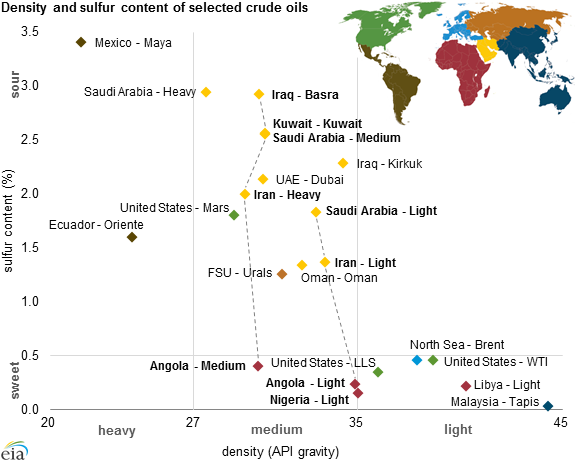
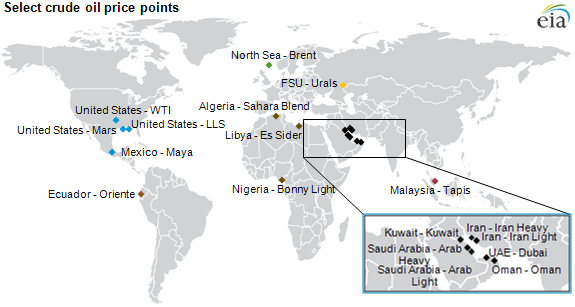
Note: See geographic location of crude oil price points.
Principal contributors: Alexander Metelitsa, Asmeret Asghedom