U.S. Energy Information Administration logo
Skip to sub-navigation
March 27, 2014

Crude oil inventories at Cushing, Oklahoma, hub down 32% over the past two months
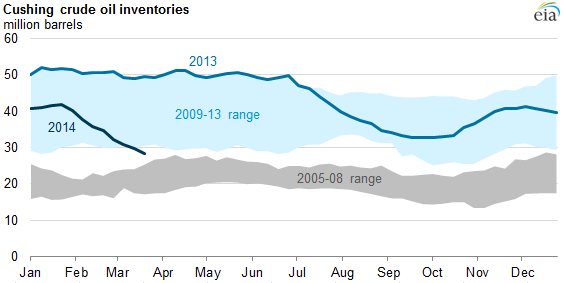
graph of Cushing crude oil inventories, as explained in the article text
Source: U.S. Energy Information Administration, Weekly Petroleum Status Report

Crude oil inventories at Cushing, Oklahoma, the primary crude oil storage location in the United States, decreased 13 million barrels (32%) over the past two months. On March 21, Cushing inventories were less than 29 million barrels, more than 20 million barrels lower than a year ago and the lowest level since early 2012. Cushing is the delivery location for the New York Mercantile Exchange (Nymex) West Texas Intermediate (WTI) crude oil futures contract.

The recent drawdown of stocks at Cushing resulted from three factors:

  • The startup of TransCanada's Cushing Marketlink pipeline, which is now moving crude oil from Cushing to the U.S. Gulf Coast
  • Sustained high crude oil runs at refineries in Petroleum Administration for Defense Districts (PADD) 2 (Midwest) and 3 (Gulf Coast), which are partially supplied from Cushing
  • Expanded pipeline infrastructure and railroad shipments that have made it possible for crude oil to bypass Cushing storage and move directly to refining centers in PADDs 1 (East Coast), 3 (Gulf Coast), and 5 (West Coast)

Despite the considerable decline in Cushing inventories, crude oil stocks remain above the top of the 2005-08 range. Over the past several years, much of the crude oil production growth from tight oil formations in the Midcontinent was delivered to Cushing storage. Because takeaway capacity from Cushing storage was insufficient, inventories there rose. Currently, Cushing inventories have fallen to levels that reflect current market conditions, and although they are reduced, the levels remain consistent with crude oil supply requirements to meet regional refinery demand.

Principal contributors: Hannah Breul, Mike Leahy

Statistics
Analysis
Tools
Education
News

Petroleum & Other Liquids

Crude oil, gasoline, heating oil, diesel, propane, and other liquids including biofuels and natural gas liquids.

Natural Gas

Exploration and reserves, storage, imports and exports, production, prices, sales.

Electricity

Sales, revenue and prices, power plants, fuel use, stocks, generation, trade, demand & emissions.

Coal

Reserves, production, prices, employment and productivity, distribution, stocks, imports and exports.

Nuclear & Uranium

Uranium fuel, nuclear reactors, generation, spent fuel.

Renewable & Alternative Fuels

Includes hydropower, solar, wind, geothermal, biomass and ethanol.

EIA Survey Forms

Forms EIA uses to collect energy data including descriptions, links to survey instructions, and additional information.

Total Energy

Comprehensive data summaries, comparisons, analysis, and projections integrated across all energy sources.

U.S. States

State energy information, including overviews, rankings, data, and analyses.

International

International energy information, including overviews, rankings, data, and analyses.

Environment

Greenhouse gas data, voluntary reporting, electric power plant emissions.

Data Tools, Apps, & Maps

Tools to customize searches, view specific data sets, study detailed documentation, and access time-series data.

Open Data

EIA's free and open data available as API, Excel add-in, bulk files, and widgets

EIA Beta

Come test out some of the products still in development and let us know what you think!

Open Source Code

EIA's open source code, available on GitHub.

RSS Feeds

Subscribe to feeds for updates on EIA products including Today in Energy and What's New.