
Ownership of U.S. petroleum refineries has changed significantly since 2000
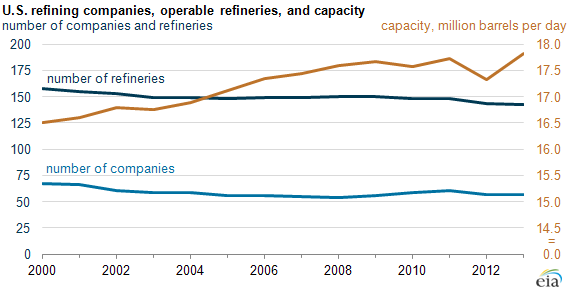
Note: All U.S. refiners (and U.S. affiliates of foreign-based refiners) are included in this figure. The data are reported as of January 1 of the indicated year.
U.S. refining capacity increased since 2000 as capacity additions outpaced the loss of capacity from three major refinery closures. Yet the number of refineries and companies both declined over the same period, as the concentration of refining capacity among the top five companies increased from 38% in 2000 to 44% in 2013.
Ownership of U.S. refinery capacity changed substantially in recent years, notwithstanding relatively slow changes in refinery capacity and the number of companies involved in the refining sector. An examination of company-level information and transactional data since 2000 shows both consolidation and dispersion. Almost 40% of large refiners (i.e., those with at least 1% of total U.S. capacity) in 2000 had exited the industry by mid-year 2013.
Many refining companies changed substantially between 2000 and mid-year 2013. Some key themes are:
- Specialization. Several large oil and gas producers with refining operations, including Marathon Oil Corporation and ConocoPhillips, transferred their refining assets to stand-alone refining companies.
- Refocus away from refining. Some companies demonstrated a lessened commitment to refining. BP and Chevron reduced their refining capacity (by 23% and 10%, respectively), but stopped well short of exiting refining. Total, Exxon Mobil, and Access Industries had slight reductions in U.S. refining capacity (5%, 3%, and 2%, respectively).
- Refocus on refining. Other companies had noticeable increases in capacity. Valero and the joint ventures Motiva (Shell and Saudi Refining) and Deer Park (Shell and Mexico's PMI Norteamerica) increased refining capacity by 277%, 23%, and 20%, respectively. Valero grew through acquiring companies and assets, while Motiva grew through investing in its assets, chiefly the expansion of the Port Arthur, Texas refinery, which is now the largest refinery in the United States.
- Vertical integration. Delta Air Lines, which owned no refining assets, purchased a refinery from ConocoPhillips and now produces jet fuel for its aircraft along with other petroleum products that it does not consume.
Historically, integrated companies divested refining assets because their profitability was volatile and relatively low, particularly when compared with oil and gas exploration and production. Purchasers were willing to acquire the divested refining assets at discounted prices. Other companies viewed the potential profitability of the refining sector more favorably, leading them to acquire other companies or assets.
The ownership of refineries today reflects multiple changes since 2000. For example, in January 2000 Tosco (5th-largest U.S. refiner), Conoco (10th-largest U.S. refiner), and Phillips (17th-largest U.S. refiner) were all separate companies, and Suncor had no U.S. refining operations.
Subsequently, Phillips acquired Tosco in 2001, merged with Conoco in 2002 (becoming ConocoPhillips), sold its Denver refinery to Suncor (whereby it entered U.S. refining) in 2003, spun off two of its refineries to create WRB Refining in 2006, sold its metro Philadelphia refinery to Delta Air Lines (whereby Delta entered U.S. refining) in April 2012, and subsequently spun off all of its remaining refineries (except a small Alaska refinery), creating Phillips 66 in May 2012 (see chart below). These and other transactions are noted in EIA's recently updated Genealogy of Major Refiners.
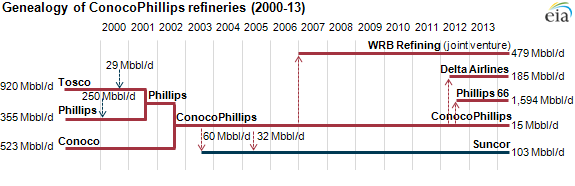
Note: Arrows indicate individual refinery transactions, e.g., Tosco's acquisition of two refineries from ARCO totaling 29,000 barrels per day (bbl/d) in January 2000 and a 250,000 bbl/d refinery from BP in September 2000, and Suncor's June 2005 acquisition of 32,000 bbl/d of refining capacity.
Principal contributor: Neal Davis