
India’s economic growth is driving its energy consumption
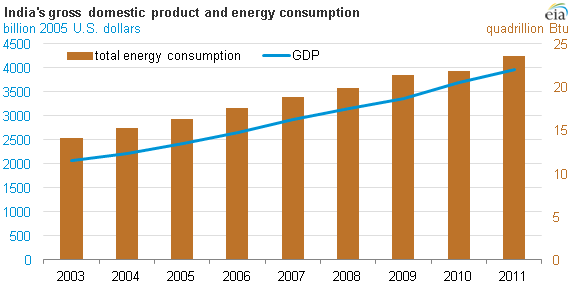
India is the fourth-largest energy consumer in the world, trailing only the United States, China, and Russia. In 2012 India had the tenth-largest economy in the world as measured in 2012 U.S. dollars (converted at official exchange rates), and the third largest economy in the world when GDP is adjusted for inflation and purchasing power. This inflation-adjusted GDP has grown at over 7% per year since 2000, although it slowed to just over 5% in 2012 according to the Indian Central Statistical Organization. As a result, the growth rate for total energy consumption likely fell from prior-year levels. However, forecasts suggest higher real GDP growth in 2013, which EIA expects to be accompanied with greater growth in energy consumption. EIA projects India and China to account for the lion's share of Asia's energy demand growth through 2035.
India's energy policy is focused on securing adequate energy resources to meet the growing demands of its economy. Primary energy consumption more than doubled between 1990 and 2011. India's dependence on imported energy resources and its inconsistent energy sector reform may make it difficult to satisfy rising demand. Despite its growing energy use, India's per capita energy consumption remains much lower than that of developed countries, such as the United States.
Other aspects of the Indian energy industry include:
- India has 211 gigawatts of installed electric capacity, mostly in coal-fired plants. Because of insufficient fuel supply, the country suffers from a shortage of electricity generation, leading to rolling blackouts.
- Coal is India's primary source of energy; the power sector accounts for more than 70% of coal consumption. India has the world's fifth-largest coal reserves.
- India was the fourth largest consumer of oil and petroleum products in the world in 2011, after the United States, China, and Japan. India relies heavily on imported crude oil, mostly from the Middle East.
- India became the world's sixth-largest liquefied natural gas importer in 2011.
- India has 20 operational nuclear reactors, with seven more under construction; as electricity demand continues to grow, India plans to increase its nuclear share of generation to 25%, up from 4% in 2011.
- Rural areas in India rely heavily on traditional biomass, as they lack access to other energy supplies. According to the 2011 India census, more than 80% of rural households use traditional biomass (including firewood and crop residue) as the primary fuel for cooking, contrasted with 22% of urban households.
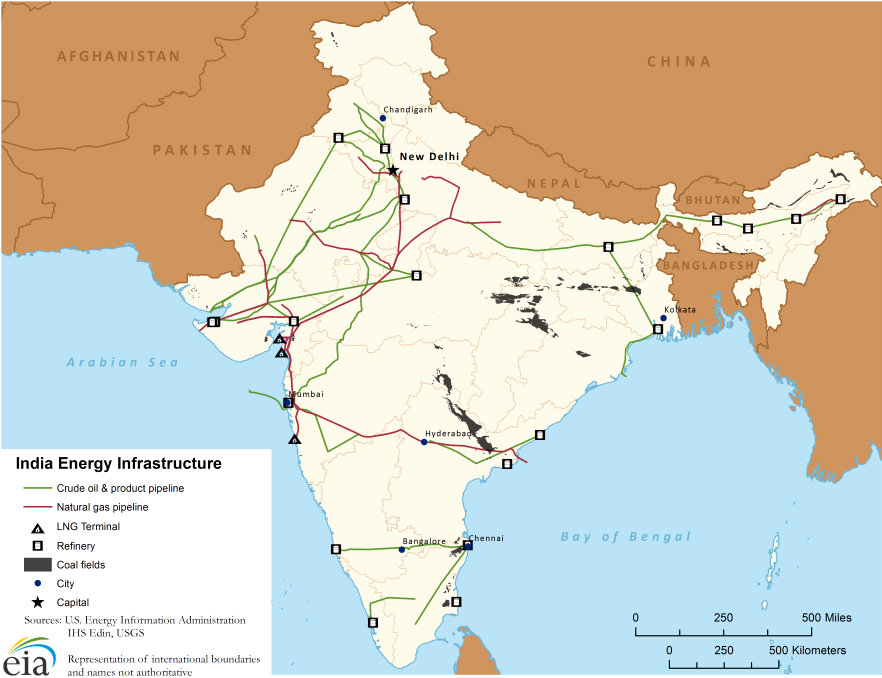
Note: Click map to enlarge.
For more information on the Indian energy industry, see EIA's Country Analysis Brief on India.
Tags: India, international, map