
Release Date: August 12, 2026
Global Energy Security Data
| million barrels | |||
| 4Q25 | 1Q26 | 2Q26 | |
|---|---|---|---|
| China | 1,397 | 1,541 | 1,492 |
| United States | 413 | 413 | 321 |
| Japan | 263 | 263 | 187 |
| Other OECD Europe | 134 | 132 | 130 |
| Saudi Arabia | 82 | 88 | 74 |
| South Korea | 79 | 78 | 69 |
| Iran | 71 | 74 | 88 |
| UAE | 34 | 41 | 35 |
| France | 33 | 33 | 33 |
| India | 21 | 21 | 21 |
| Spain | 12 | 12 | 12 |
|
Data source: U.S. Energy Information Administration, Short-Term Energy Outlook, August 2026 Note: Estimates derived from the International Energy Agency, China National Bureau of Statistics, Vortexa Analytics, Kayrros, Kpler, Argus Media, Global Trade Tracker, and Indian Strategic Petroleum Reserves Limited; 4Q25=fourth quarter of 2025; Data for 2Q26 are through June 2026 or the latest available. |
|||
| million barrels per day | ||||||
| 1Q25 | 2Q25 | 3Q25 | 4Q25 | 1Q26 | 2Q26 | |
|---|---|---|---|---|---|---|
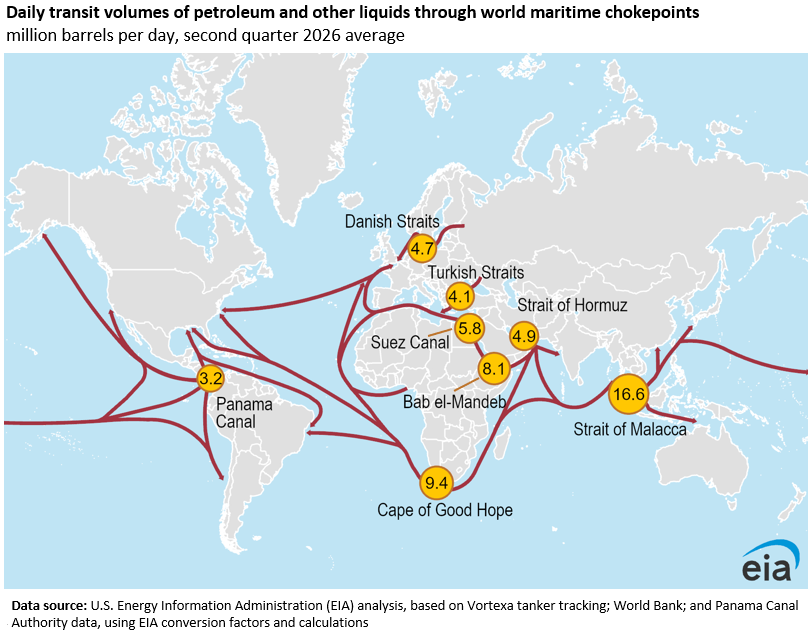
| Strait of Malacca | 22.3 | 23.8 | 23.4 | 24.9 | 21.3 | 16.6 |
| Strait of Hormuz | 20.9 | 21.0 | 21.3 | 21.6 | 14.9 | 4.9 |
| Suez Canal and SUMED Pipeline | 4.6 | 5.1 | 5.6 | 5.9 | 5.7 | 5.8 |
| Bab el-Mandeb | 3.9 | 4.5 | 4.6 | 5.4 | 5.6 | 8.1 |
| Danish Straitsa | 5.0 | 4.8 | 4.9 | 5.0 | 4.9 | 4.7 |
| Turkish Straits (Dardanelles) | 3.8 | 3.7 | 3.7 | 3.7 | 3.3 | 4.1 |
| Panama Canal | 2.8 | 2.5 | 2.8 | 2.8 | 2.9 | 3.2 |
| Cape of Good Hope | 9.0 | 9.3 | 9.0 | 9.9 | 8.2 | 9.4 |
| World total oil supply | 105.0 | 107.7 | 108.2 | 103.9 | 96.1 | 99.7 |
|
Data source: U.S. Energy Information Administration, Short-Term Energy Outlook, August 2026 and EIA analysis based on Vortexa tanker tracking and Panama Canal Authority data, using EIA conversion factors and calculations Note: World maritime oil trade excludes intra-country volumes except those volumes that transit global chokepoints and the Cape of Good Hope. 1Q25=first quarter of 2025. a The Danish Straits do not include flows through the Kiel Canal. |
||||||
| million barrels per day | ||||||
| 1Q25 | 2Q25 | 3Q25 | 4Q25 | 1Q26 | 2Q26 | |
|---|---|---|---|---|---|---|
| Total oil flows through the Strait of Malacca | 22.3 | 23.8 | 23.4 | 24.0 | 21.3 | 16.6 |
| Crude oil and condensate | 15.8 | 17.1 | 16.2 | 18.0 | 14.9 | 11.4 |
| Petroleum products | 6.4 | 6.7 | 7.2 | 6.9 | 6.4 | 5.2 |
| LNG flows through the Strait of Malacca (billion cubic feet per day) | 9.1 | 9.5 | 8.9 | 10.1 | 8.3 | 5.5 |
|
Data source: U.S. Energy Information Administration analysis based on Vortexa tanker tracking data Note: LNG=liquefied natural gas; 1Q25=first quarter of 2025. |
||||||
| million barrels per day | ||||||
| 1Q25 | 2Q25 | 3Q25 | 4Q25 | 1Q26 | 2Q26 | |
|---|---|---|---|---|---|---|
| Total oil flows through the Strait of Hormuz | 20.9 | 21.0 | 21.3 | 21.6 | 14.9 | 4.9 |
| Crude oil and condensate | 14.8 | 14.9 | 15.0 | 15.9 | 10.9 | 3.7 |
| Petroleum products | 6.2 | 6.2 | 6.3 | 5.7 | 4.0 | 1.1 |
| LNG flows through the Strait of Hormuz (billion cubic feet per day) | 11.7 | 11.0 | 10.9 | 10.5 | 7.4 | 0.8 |
|
Data source: U.S. Energy Information Administration analysis based on Vortexa tanker tracking data Note: LNG=liquefied natural gas; 1Q25=first quarter of 2025. |
||||||
| million barrels per day | ||||||
| 1Q25 | 2Q25 | 3Q25 | 4Q25 | 1Q26 | 2Q26 | |
|---|---|---|---|---|---|---|
| Total oil flows through the Suez Canal and SUMED pipeline | 4.6 | 5.1 | 5.6 | 5.9 | 5.7 | 5.8 |
| Crude oil and condensate | 2.8 | 2.9 | 3.1 | 3.6 | 3.2 | 3.6 |
| Petroleum products | 1.9 | 2.2 | 2.5 | 2.3 | 2.5 | 2.2 |
| LNG flows through the Suez Canal (billion cubic feet per day) | 0.8 | 0.8 | 2.1 | 1.6 | 1.8 | 1.5 |
|
Data source: U.S. Energy Information Administration analysis based on Vortexa tanker tracking data Note: LNG=liquefied natural gas; 1Q25=first quarter of 2025. |
||||||
| million barrels per day | ||||||
| 1Q25 | 2Q25 | 3Q25 | 4Q25 | 1Q26 | 2Q26 | |
|---|---|---|---|---|---|---|
| Total oil flows through the Bab el-Mandeb Strait | 3.9 | 4.5 | 4.6 | 5.4 | 5.6 | 8.1 |
| Crude oil and condensate | 2.1 | 2.6 | 2.6 | 3.2 | 3.4 | 6.1 |
| Petroleum products | 1.7 | 1.8 | 2.0 | 2.2 | 2.2 | 2.0 |
| LNG flows through the Bab el-Mandeb Strait (billion cubic feet per day) | 0.3 | - | - | 1.1 | 3.0 | - |
|
Data source: U.S. Energy Information Administration analysis based on Vortexa tanker tracking data Note: LNG=liquefied natural gas; 1Q25=first quarter of 2025. |
||||||
| million barrels per day | ||||||
| 1Q25 | 2Q25 | 3Q25 | 4Q25 | 1Q26 | 2Q26 | |
|---|---|---|---|---|---|---|
| Total oil flows through the Danish Straits | 5.0 | 4.8 | 4.9 | 5.0 | 4.9 | 4.7 |
| Crude oil and condensate | 2.7 | 2.7 | 2.8 | 2.9 | 2.7 | 3.0 |
| Petroleum products | 2.3 | 2.1 | 2.1 | 2.2 | 2.1 | 1.7 |
| LNG flows through the Danish Straits (billion cubic feet per day) | 1.6 | 1.6 | 1.5 | 1.9 | 1.8 | 1.4 |
|
Data source: U.S. Energy Information Administration analysis based on Vortexa tanker tracking data Note: LNG=liquefied natural gas; 1Q25=first quarter of 2025. |
||||||
| million barrels per day | ||||||
| 1Q25 | 2Q25 | 3Q25 | 4Q25 | 1Q26 | 2Q26 | |
|---|---|---|---|---|---|---|
| Total oil flows through the Turkish Straits (Dardanelles) | 3.8 | 3.7 | 3.7 | 3.7 | 3.3 | 4.1 |
| Crude oil and condensate | 2.3 | 2.2 | 2.2 | 2.2 | 1.9 | 2.7 |
| Petroleum products | 1.5 | 1.5 | 1.5 | 1.5 | 1.4 | 1.4 |
| LNG flows through the Turkish Straits (Dardanelles) (billion cubic feet per day) | 1.1 | 0.3 | 0.2 | 0.8 | 0.8 | 0.3 |
|
Data source: U.S. Energy Information Administration analysis based on Vortexa tanker tracking data Note: LNG=liquefied natural gas; 1Q25=first quarter of 2025. |
||||||
| million barrels per day | ||||||
| 1Q25 | 2Q25 | 3Q25 | 4Q25 | 1Q26 | 2Q26 | |
|---|---|---|---|---|---|---|
| Total oil flows through the Panama Canal | 2.8 | 2.5 | 2.8 | 2.8 | 2.9 | 3.2 |
| Crude oil and condensate | 0.1 | 0.1 | 0.1 | 0.1 | 0.1 | 0.2 |
| Petroleum products | 2.7 | 2.4 | 2.6 | 2.7 | 2.8 | 3.0 |
| LNG flows through the Panama Canal (billion cubic feet per day) | 0.2 | 0.3 | 0.4 | 0.3 | 0.3 | 0.6 |
|
Data source: U.S. Energy Information Administration analysis based on Vortexa tanker tracking data Note: LNG=liquefied natural gas; 1Q25=first quarter of 2025. |
||||||
| million barrels per day | ||||||
| 1Q25 | 2Q25 | 3Q25 | 4Q25 | 1Q26 | 2Q26 | |
|---|---|---|---|---|---|---|
| Total oil flows around the Cape | 9.0 | 9.3 | 9.0 | 9.9 | 8.2 | 9.4 |
| Crude oil and condensate | 6.0 | 6.4 | 5.6 | 7.0 | 5.6 | 6.7 |
| Petroleum products | 3.0 | 3.0 | 3.4 | 2.9 | 2.6 | 2.7 |
| LNG flows around the Cape (billion cubic feet per day) | 4.2 | 7.0 | 6.3 | 6.0 | 4.8 | 9.7 |
|
Data source: U.S. Energy Information Administration analysis based on Vortexa tanker tracking data Note: LNG=liquefied natural gas; 1Q25=first quarter of 2025. |
||||||
Methodology
Strategic Petroleum Reserves
We take a conservative approach in estimating strategic oil inventories. For countries without a specified strategic petroleum reserve, we define strategic inventories as those owned by governments or national oil companies (NOCs) and, for a few countries, only inventories held in on-land storage. In addition, we do not include inventories in commercial, floating, or underground storage facilities. While some countries, like Japan, also require private companies to hold barrels in commercial inventories for strategic purposes, we only include government-owned inventories or those held by government-owned NOCs for this estimation.
We also limit our analysis to the 10 countries with the largest estimated current strategic oil inventories and on-land storage capacity, which together equal about 70% of global totals. China does not report data on its oil inventories, so we estimate China’s inventories based on production, imports, exports, refining, and oil inventory data from third-party and official sources. For this analysis, we consider both China’s government-held and commercial inventories to be part of strategic oil inventories, based on reports that China’s NOCs have been directed since 2024 to add emergency oil to commercial stockpiles, which effectively act as a second source of strategic inventories. EIA provides U.S. Strategic Petroleum Reserve data, while government strategic oil inventory data for OECD Asia and Europe are taken from the latest edition of the International Energy Agency’s Oil Market Report. For non-OECD countries in the Middle East, we estimate strategic inventories based on average refinery and commercial on-land inventories reported by Vortexa and Kpler.
Global Chokepoints
All dates are based on the date that the cargo entered the given chokepoint. Volumes for the Danish Straits (Great Belt or Oresund), Turkish Straits (Dardanelles), the Panama Canal, and the Cape of Good Hope are EIA estimates based on Vortexa data. In previous EIA publications, data for the Panama Canal were sourced from the Panama Canal Authority. Suez Canal and SUMED pipeline volumes are based on Vortexa data with non-lightered SUMED volumes estimated based on net volumes loaded at Egypt’s Sidi Kerir port.
Much of the data underlying this analysis are based on information that ships broadcast through Automatic Identification System (AIS) signals. However, this data may be incomplete if the AIS signal has been manipulated or turned off for some part of the journey, whether for illicit reasons, such as to obscure the origin of the cargo in order to evade sanctions, or for security reasons when transiting hazardous areas. To account for volumes through the Strait of Hormuz, the Bab el-Mandeb, and the Strait of Malacca that may be obfuscated in this way, EIA has supplemented volumes based on Vortexa data with additional analysis of origin and destination ports and other available route information for cargos not otherwise identified as passing through those chokepoints. Waypoint entry dates for these cargos are estimated by EIA. Since the end of February 2026, AIS signal data for ships transiting the Strait of Hormuz have become especially unreliable. For 2026 Hormuz volumes, tanker tracking data are being revised frequently based on the best available information. EIA volumes are based on Vortexa data with additional EIA analysis.