
ENERGY STAR homes accounted for 26% of new construction in 2011
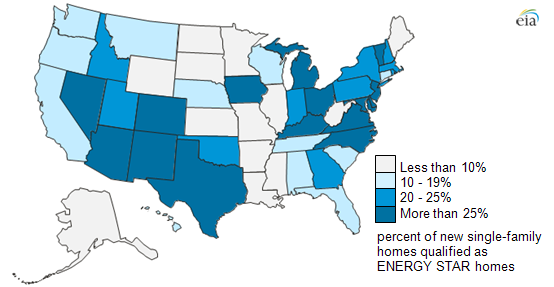
Note: Percentages represent number of ENERGY STAR single-family homes as a percentage of single-family housing completions reported by the Census Bureau.
Homes built to voluntary ENERGY STAR® specifications made up about 26% of all new homes constructed in the United States during 2011. Under the latest update of the specifications that went into effect earlier this year, ENERGY STAR homes consume at least 15% less energy than those built to the 2009 International Energy Conservation Code (IECC).
There is currently no national building energy code. States have adopted a variety of codes with different levels of stringency, mostly based on the IECC, a building energy code created by the International Code Council. Often the stringency of these state building codes and ENERGY STAR participation is correlated: all but one of the eight states lacking a statewide energy code have low ENERGY STAR participation, while Arizona's strong utility support for energy-efficient construction has fostered a high penetration of ENERGY STAR qualified homes, even though there is no statewide code there.
The U.S. Environmental Protection Agency (EPA) initiated the ENERGY STAR specification for residential construction in 1995, creating homes that were 30% more efficient than the 1992 Model Energy Code (MEC). The specifications were revised to create Version 2 in 2006, and Version 3 was released in 2012.
A home can get ENERGY STAR certification in one of two ways: the prescriptive path or performance path. Both paths have program requirements common to all qualifying homes across the nation. The prescriptive path incorporates predefined improvements based on a home's IECC climate zone, while the performance path uses home energy modeling to account for savings based on a more flexible use of energy savings measures. A certified Residential Energy Services Network (RESNET) home energy rater verifies that specific requirements of the guidelines are met.
Tags: buildings, efficiency, energy efficiency, Energy Star, New Jersey, Oregon, residential, states