
Attributes of crude oil at U.S. refineries vary by region
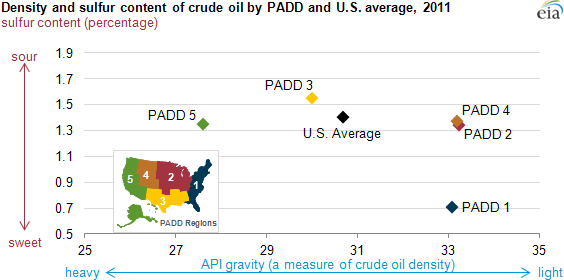
Note: PADDs (Petroleum Administration for Defense Districts) are geographic aggregations that allow regional analysis of petroleum markets.
Note: Sweet refers to the absence of hydrogen sulfide (H2S) in crude oil, which typically corresponds to low sulfur content. Sour refers to high H2S content, and a typically high sulfur content.
Crude oil has unique qualities and commands different prices depending on these qualities. In addition to quality considerations, location and local refining capability influence a crude's value. Two key characteristics of crude oil are density and sulfur content. Density ranges from light to heavy, while sulfur content is characterized as sweet or sour. The purchase costs of various crude oils depend mainly on density and sulfur content, and other factors such as location and transportation costs.
Refining capacity in the Gulf Coast has large secondary conversion capacity including hydrocrackers, cokers, and desulfurization units. These units enable the processing of heavy, high sulfur (sour) crude oils like Mexican Maya that typically sell at a discount to light, low sulfur (sweet) crudes like Brent and Louisiana Light Sweet. Many East Coast refineries have less secondary conversion capacity, and in general they process crude oil with lower sulfur content and a lighter density. This lighter, lower sulfur crude oil commands a premium price on world markets.
In recent years, crude production has risen dramatically in Canada (heavy, sour crude) and the United States (high-quality light, sweet crude), providing these types of oil to U.S. refiners. The new U.S. production often sells at a discount to poorer quality crudes because of storage and transportation constraints. Refineries across the country are developing strategies to acquire the new domestic crude streams to replace more expensive imports of high-quality crude oil. Gulf Coast refiners are also seeking more access to Canadian crudes to replace declining supplies of heavy, sour crudes from Mexico and Venezuela (Venezuelan crudes, while heavy, tend to have lower sulfur content than Maya).
Tags: Canada, crude oil, Gulf Coast, oil/petroleum, production/supply, refining