
Worst drought in decades could affect U.S. energy markets
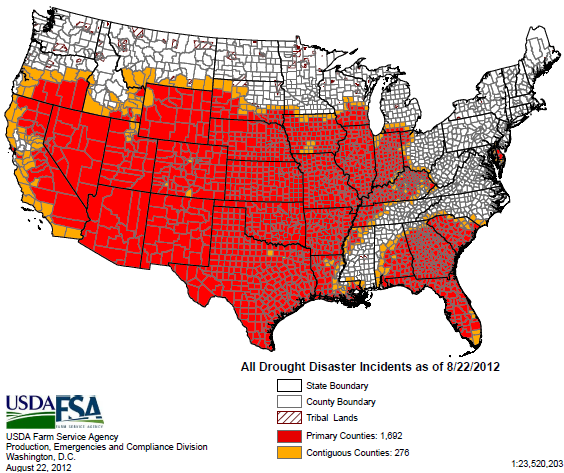
Note: Primary designation refers to a county's status as drought affected while a contiguous designation refers to those counties on the boundary of a drought affected county.
Despite the imminent landfall of Hurricane Isaac in the Gulf Coast, the United States is currently experiencing its worst drought in decades, as measured by the U.S. National Oceanic and Atmospheric Administration (NOAA). Droughts have relatively well-understood impacts on food crops and markets. But droughts can also affect energy markets. A significant amount of corn production is used to produce ethanol, which makes up about 10% of the motor gasoline pool by volume and provides 6%–7% of the gasoline's energy content. And since the generation of electricity can be very water-intensive, droughts affect the power sector.
Drastically reduced rainfall and triple-digit temperatures throughout much of the nation have damaged corn and other crops, which will have significant impacts on supplies and prices for animal feed, livestock, meat and dairy products, and processed grain products, including ethanol. The drought has also disrupted the transportation of some commodities, such as petroleum and coal, that are delivered by barges on the Mississippi River. The U.S. Army Corps of Engineers has reported groundings of traffic along the Mississippi River due to low water depths, and NOAA has stated that portions of the Mississippi River south of Memphis are below the 1988 low-water level. Droughts can also create reliability concerns for electric power plants. Increased temperatures drive demand for electricity to cool homes and businesses, but lower water levels can affect the operation of many thermoelectric power plants.
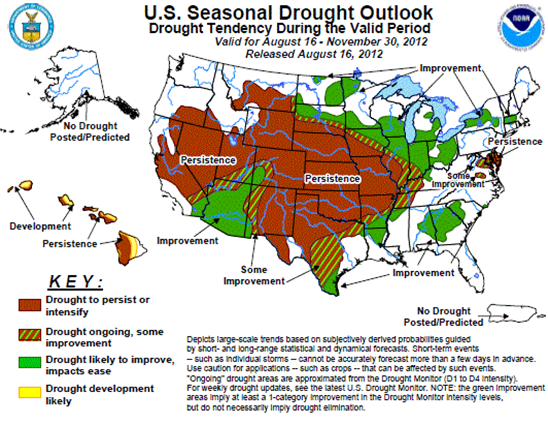
The U.S. Drought Monitor, a joint publication of USDA and NOAA, is currently reporting that large areas of the Midwest and Great Plains regions are experiencing significant drought conditions. NOAA's Climate Prediction Center (CPC), integrating Drought Monitor data with weather forecasting, is predicting that the drought conditions will remain mostly unchanged through the end of November.
An upcoming series of Today in Energy articles will focus on the impact of the drought on various energy sectors in the United States.