U.S. Energy Information Administration logo
Skip to sub-navigation
August 2, 2012

U.S. proved reserves increased sharply in 2010
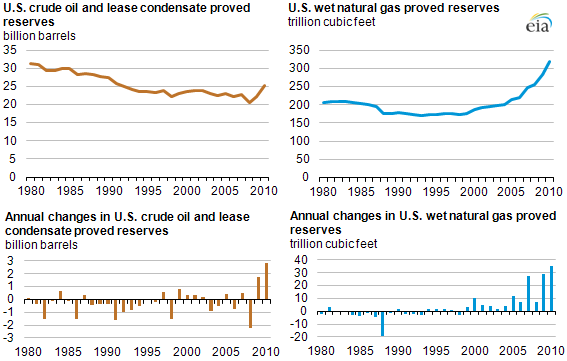
graphs of proved reserves and changes in proved reserves for oil and natural gas, as described in the article text
Source: U.S. Energy Information Administration, U.S. Crude Oil, Natural Gas, and Natural Gas Liquids Proved Reserves, 2010.

On August 1, the U.S. Energy Information Administration (EIA) released its summary of the nation's proved reserves of oil and natural gas for 2010. Proved reserves of both oil and natural gas in 2010 rose by the highest amounts ever recorded in the 35 years EIA has been publishing proved reserves estimates.

Technological advances in drilling and higher prices contributed to gains in reserves. The expanding application of horizontal drilling and hydraulic fracturing in shale and other "tight" (very low permeability) formations, the same technologies that spurred substantial gains in natural gas proved reserves in recent years, played a key role. Further, rising oil and natural gas prices between 2009 and 2010 likely provided incentives to explore and develop more resources.

Oil proved reserves (which include crude oil and lease condensate) rose 12.8% to 25.2 billion barrels in 2010, marking the second consecutive annual increase and the highest volume since 1991. Natural gas proved reserves (estimated as "wet" natural gas, including natural gas plant liquids) increased by 11.9% in 2010 to 317.6 trillion cubic feet (Tcf), the twelfth consecutive annual increase, and the first year U.S. proved reserves for natural gas surpassed 300 Tcf.

Proved reserves reflect volumes of oil and natural gas that geologic and engineering data demonstrate with reasonable certainty to be recoverable in future years from known reservoirs under existing economic and operating conditions. It should be noted that the 2010 summary was delayed due to budgetary restrictions that limited EIA's survey data collection efforts.

Statistics
Analysis
Tools
Education
News

Petroleum & Other Liquids

Crude oil, gasoline, heating oil, diesel, propane, and other liquids including biofuels and natural gas liquids.

Natural Gas

Exploration and reserves, storage, imports and exports, production, prices, sales.

Electricity

Sales, revenue and prices, power plants, fuel use, stocks, generation, trade, demand & emissions.

Coal

Reserves, production, prices, employment and productivity, distribution, stocks, imports and exports.

Nuclear & Uranium

Uranium fuel, nuclear reactors, generation, spent fuel.

Renewable & Alternative Fuels

Includes hydropower, solar, wind, geothermal, biomass and ethanol.

EIA Survey Forms

Forms EIA uses to collect energy data including descriptions, links to survey instructions, and additional information.

Total Energy

Comprehensive data summaries, comparisons, analysis, and projections integrated across all energy sources.

U.S. States

State energy information, including overviews, rankings, data, and analyses.

International

International energy information, including overviews, rankings, data, and analyses.

Environment

Greenhouse gas data, voluntary reporting, electric power plant emissions.

Data Tools, Apps, & Maps

Tools to customize searches, view specific data sets, study detailed documentation, and access time-series data.

Open Data

EIA's free and open data available as API, Excel add-in, bulk files, and widgets

EIA Beta

Come test out some of the products still in development and let us know what you think!

Open Source Code

EIA's open source code, available on GitHub.

RSS Feeds

Subscribe to feeds for updates on EIA products including Today in Energy and What's New.