Asian demand spurs U.S. net exports of petroleum coke to higher levels in early 2012
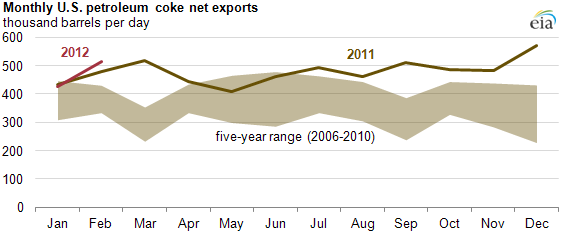
U.S. net exports of petroleum coke—a byproduct of oil refining —continued at higher levels over the combined January-February 2012 period. Demand for U.S. petroleum coke, or sometimes called "petcoke," is strongest in Asia, where it is used for generating electricity, making steel, and manufacturing cement.
U.S. petroleum coke net exports averaged about 470 thousand barrels per day (bbl/d) during January-February 2012, the highest volume ever for that two-month period, according to the most recent trade data from EIA's April Petroleum Supply Monthly (see chart above).
On an annual basis, the U.S. net exports of petcoke averaged a record 479 thousand bbl/d during 2011, second among petroleum products only to distillate fuel. Average petcoke net exports last year exceeded volumes for gasoline (374 thousand bbl/d), residual fuel oil (78 thousand bbl/d), fuel ethanol (69 thousand bbl/d), and jet fuel (28 thousand bbl/d).
Oil refiners produce petcoke as a byproduct from refining crude oil. The heavier a particular crude oil is, the more petroleum coke it will generally yield. Because heavier crudes often have a high sulfur content, petcoke also tends to have a high sulfur content. Although it comes from liquid oil, petcoke is a solid rock-like material similar to coal. Petcoke is used as fuel at power plants to generate electricity, by the smelting industry to create aluminum and steel, and as a fuel for cement making. While it may sound similar, coking coal is coal that is superheated to drive off impurities and is used as a fuel and reducing agent in smelting iron ore in a blast furnace to make iron and steel.
Petcoke is one of several petroleum products U.S. refiners make from crude oil. While petcoke is not worth as much as other high-priced petroleum products (such as gasoline and diesel fuel) refined from a barrel of crude oil, it was a major contributor to the United States becoming a net exporter of petroleum products in 2011 for the first time since 1949.
EIA categorizes three types of petcoke from refineries:
- Catalyst Petcoke is used in the petroleum refining process. It is usually burned as fuel at the oil refinery and does not contribute to exports.
- Marketable Fuel-Grade Petcoke contains higher sulfur and heavy metals content than most coal and is used mainly as a fuel at cement plants and power plants.
- Marketable Calcined Petcoke has the highest carbon purity and is used to make electrical components, such as capacitors.
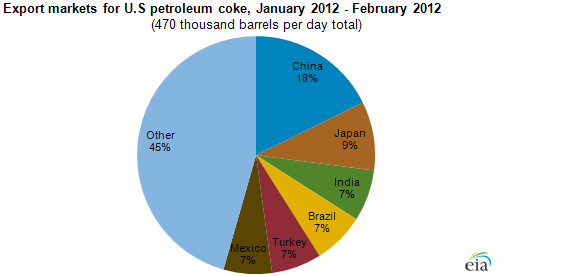
The United States provides over one-half of the petcoke traded in the global market. China buys more U.S. petcoke than any other country; shipments averaged 86 thousand bbl/d during the January 2012 to February 2012 period, double the volumes from a year earlier. After China, the biggest export markets for American petcoke include Japan, India, Brazil, Turkey, and Mexico. These six countries collectively accounted for more than half of U.S. petcoke exports during the first two months of 2012 (see chart below), and the remaining 45% of exports went to about two dozen other countries.