
2022 Appalachian natural gas production flat with productivity declines in key counties
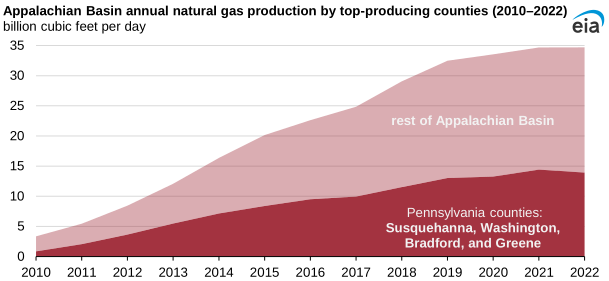
Natural gas production in the Appalachian Basin remained flat in 2022 as production from a group of four key Pennsylvania counties declined.
The Susquehanna, Washington, Bradford, and Greene counties in Pennsylvania produced 40%—13.9 billion cubic feet per day (Bcf/d)—of the 34.7 Bcf/d of natural gas produced in the Appalachian Basin in 2022. The 13.9 Bcf/d produced in the four counties last year represents a 3% decline compared with output in 2021. Natural gas production from the Appalachian Basin, home to the Marcellus shale formation, was relatively flat in 2022 compared with 2021 after increasing every year since 2010.
A combined 207 counties across 8 states produced the remaining 60% of natural gas. The Appalachian Basin is the largest natural gas-producing region in the United States, comprising nearly one-third (29%) of total U.S. production in 2022.
Productivity declines and limits on natural gas takeaway capacity resulted in a 0.4 Bcf/d decrease in Pennsylvania’s total natural gas production in 2022. Until last year, output had increased every year since 2013 on the back of drilling efficiency gains. One measure of drilling efficiency is the average volume of natural gas produced in wells during the first six months of drilling. Drilling efficiency at Pennsylvania’s natural gas wells increased every year since 2013 before declining for the first time in 2022.
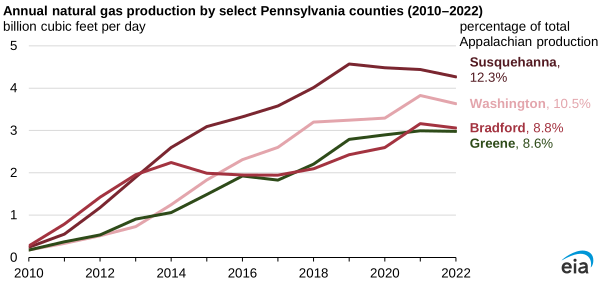
Of the four top producing counties, only Greene County increased its average annual production in 2022 compared with 2021. Overall, Susquehanna County has produced the most natural gas since 2014, averaging more than 4.0 Bcf/d since 2018. Washington, Bradford, and Greene counties have each produced more than 3.0 Bcf/d in 2021 and 2022.
Production in the Appalachian Basin is primarily concentrated in three states—Pennsylvania, Ohio, and West Virginia—but also includes production in parts of New York, Kentucky, Tennessee, Virginia, and Alabama. Production in the Appalachian Basin grew from 3.3 Bcf/d in 2010 to 34.7 Bcf/d in 2021 because of improved hydraulic fracturing techniques and more horizontal drilling.
Principal contributors: Troy Cook, Max Ober
Tags: production/supply, natural gas, Marcellus