
Crude oil prices forecast to decline beginning in the second half of 2023
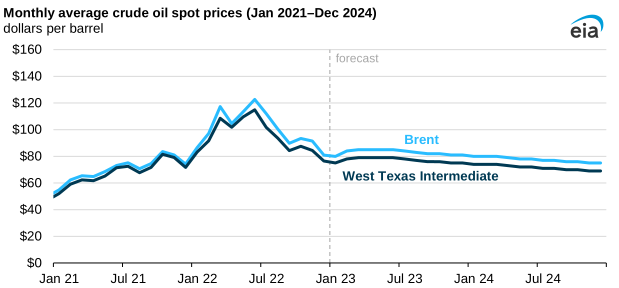
In our January 2023 Short-Term Energy Outlook, we forecast the Brent crude oil price (the global benchmark) will rise from an average $81 per barrel (b) in December 2022 to average $83/b in the first quarter of 2023 (1Q23). We expect this forecast increase to follow the upcoming EU ban on seaborne imports of petroleum products from Russia, effective February 5. This ban will likely be more disruptive to the global petroleum markets than the EU’s December 2022 ban on seaborne crude oil imports from Russia (STEO Between the Lines includes more in-depth discussion). We forecast the Brent price will stay relatively flat through 2Q23, averaging $85/b, and then decline through the end of 2024. We expect the Brent price will average $83/b in 2023 and $78/b in 2024, down from $101/b in 2022. The West Texas Intermediate (WTI) price (the U.S. benchmark price) is forecast to generally follow a similar path, averaging $77/b in 2023 and $72/b 2024.
Implied builds in global petroleum inventories (when there is more petroleum production than consumption) are driving these declines in crude oil prices. We forecast global petroleum inventory builds will average more than 0.6 million b/d in 2023–24.
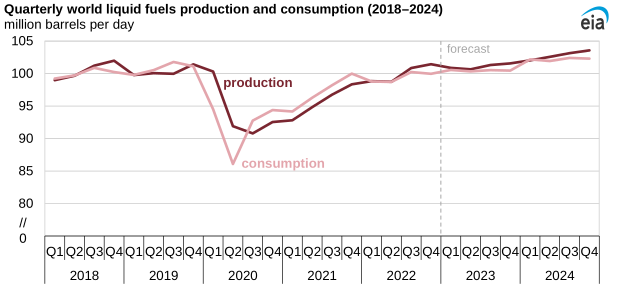
We forecast that global petroleum production will increase by 1% (1.1 million b/d) from 2022 to 2023. The United States and OPEC account for most of the increase in global production, offsetting production declines in Russia. We forecast that Russia’s petroleum production will fall from 10.9 million b/d in 2022 to 9.5 million b/d in 2023 as a result of sanctions related to Russia’s full-scale invasion of Ukraine. We forecast that U.S. production will grow by 5% (1.0 million b/d) in 2023, and OPEC liquid fuels production (which includes crude oil) will increase by 0.5% (160,000 b/d) in 2023.
We forecast that global petroleum production in 2024 will increase by 2% (1.7 million b/d), driven by increases in U.S. and OPEC production. In 2024, we forecast that U.S. petroleum production will increase by 3% (650,000 b/d), and OPEC production will increase by 2% (680,000 b/d). Russia’s petroleum production is expected to be nearly flat in 2024.
Our assumed global GDP growth—based on forecasts from Oxford Economics—averages 1.8% in 2023 and 3.3% in 2024, contributing to increasing petroleum demand. We forecast that global liquid fuels consumption will increase 1% in 2023 (1.0 million b/d), followed by an increase of 2% (1.7 million b/d) in 2024. Our forecast for petroleum consumption in 2024 surpasses consumption in 2019. Petroleum consumption growth is driven by rising petroleum demand in China and India in both years.
Principal contributor: Matthew French