U.S. Energy Information Administration logo
Skip to sub-navigation
March 13, 2012

The U.S. surpassed Russia as world’s leading producer of dry natural gas in 2009 and 2010
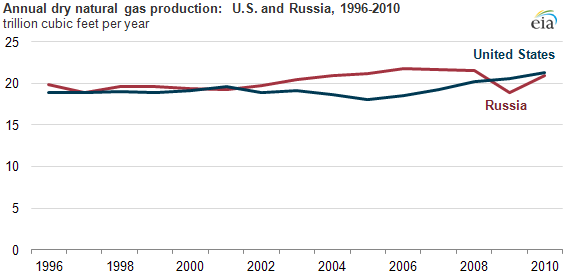
graph of Annual dry natural gas production: U.S. and Russia, 1996-2010, as described in the article text
Source: U.S. Energy Information Administration.
Download CSV Data

EIA estimates of annual dry natural gas production indicate that the United States surpassed Russia as the world's leading producer of dry natural gas beginning in 2009 when Russian production dropped in conjunction with the economic downturn and reduced demand (see chart above). Both countries produced more than 20 trillion cubic feet (Tcf) of dry natural gas in 2010. Definitive comparisons of natural gas production trends in the two countries are imprecise due to differences in terminology and reporting methodologies.

Dry natural gas production in the United States rose 18% between 2005 and 2010—mainly due to growth in shale gas production. Increased use of horizontal drilling in conjunction with hydraulic fracturing spurred natural gas supply gains. Other factors contributed to gains in natural gas production: improved site planning and field optimization, multi-well drilling from a single pad, rising associated natural gas production from oil plays, and improved drill-bit technology. According to Lippman Consulting, annual shale natural gas production in key shale plays grew from 1.6 Tcf to 7.2 Tcf between 2007 and 2011 (see chart below).
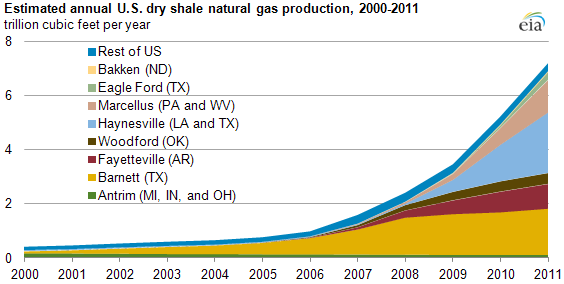
graph of Estimated annual U.S. dry shale gas production, 2000-2011, as described in the article text
Source: U.S. Energy Information Administration, based on Lippman Consulting, Inc.
Note: Lippman Consulting, Inc. gross withdrawal estimates, as of December 2011, converted to dry production estimates with EIA-calculated average gross-to-dry shrinkage factors by state and/or shale play.

Since 1996, Russia's dry natural gas production record has been mixed. It was relatively unchanged between 1996 and 2001, grew to almost 22 Tcf in 2006, and then remained relatively stable before declining in 2009. Two factors leading to this decline were a slow-down in domestic natural gas consumption in Russia and Russian suppliers' cutbacks to match reduced gas needs in Europe. Russian dry natural gas production rebounded somewhat in 2010, although the best available data indicate it remained about 2% lower than U.S. production of natural gas that year.

Statistics
Analysis
Tools
Education
News

Petroleum & Other Liquids

Crude oil, gasoline, heating oil, diesel, propane, and other liquids including biofuels and natural gas liquids.

Natural Gas

Exploration and reserves, storage, imports and exports, production, prices, sales.

Electricity

Sales, revenue and prices, power plants, fuel use, stocks, generation, trade, demand & emissions.

Coal

Reserves, production, prices, employment and productivity, distribution, stocks, imports and exports.

Nuclear & Uranium

Uranium fuel, nuclear reactors, generation, spent fuel.

Renewable & Alternative Fuels

Includes hydropower, solar, wind, geothermal, biomass and ethanol.

EIA Survey Forms

Forms EIA uses to collect energy data including descriptions, links to survey instructions, and additional information.

Total Energy

Comprehensive data summaries, comparisons, analysis, and projections integrated across all energy sources.

U.S. States

State energy information, including overviews, rankings, data, and analyses.

International

International energy information, including overviews, rankings, data, and analyses.

Environment

Greenhouse gas data, voluntary reporting, electric power plant emissions.

Data Tools, Apps, & Maps

Tools to customize searches, view specific data sets, study detailed documentation, and access time-series data.

Open Data

EIA's free and open data available as API, Excel add-in, bulk files, and widgets

EIA Beta

Come test out some of the products still in development and let us know what you think!

Open Source Code

EIA's open source code, available on GitHub.

RSS Feeds

Subscribe to feeds for updates on EIA products including Today in Energy and What's New.