U.S. Energy Information Administration logo
Skip to sub-navigation
March 2, 2012

Electricity's share of U.S. delivered energy has risen significantly since 1950
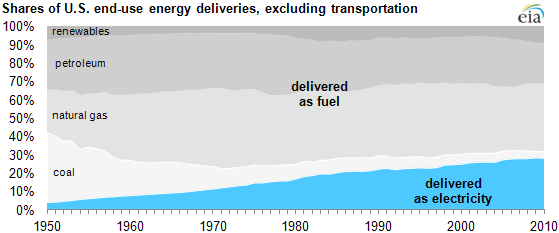
graph of Share of U.S. end-use energy deliveries, excluding transportation, as described in the article text
Source: U.S. Energy Information Administration, Annual Energy Review.

The share of energy that is delivered in the form of electricity has been growing steadily over the past 60 years. Leaving aside the transportation sector, which is mostly petroleum-based, the percentage of energy delivered to the site of use in the form of electricity grew from 4% in 1950 to 29% in 2010.

Clearly, we rely a great deal more today on electrical end-use devices than in 1950. Many homes and business that once burned coal directly now use other fuels or electricity. The use of labor-saving equipment in industry and home appliances has expanded greatly over the period.

Another factor in the growth in electricity's share of delivered energy is that, for certain sources of energy, it is not practical to deliver the energy in its original form to the site of use. Few consumers have a dam on the premises. The output of hydroelectric dams grew significantly in the 1960s. Uranium is used to produce electricity in large central station power plants. Nuclear generation grew significantly in the 1970s and 1980s.

Focusing on electricity's share of energy used on site (delivered electricity) masks the original (or primary) amount of energy that goes into producing electricity. If we include the energy lost in generating and transmitting electricity, its share rises to 56% of non-transportation energy consumption. In the chart below, the coal, natural gas, petroleum and renewables used to produce electricity are included in energy for electricity. These energy types also are shown separately as energy delivered as fuel and often burned to provide heat.

The ratio of electricity-related losses to delivered electricity highlights the transformation losses incurred in converting fuels to electricity. In 1950, only 21% of the energy content of fuels was delivered to end-users in the form of electricity. Today, that percentage has increased to 32%. However, this analysis leaves out the significant inefficiencies involved in burning fuel at the site of use.
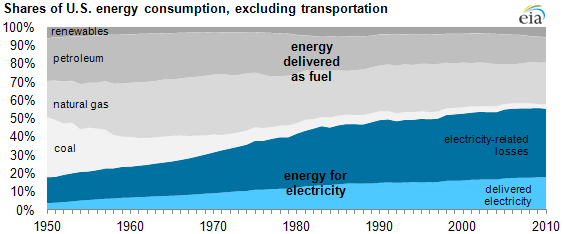
graph of Share of U.S. energy consumption, excluding transportation, as described in the article text
Source: U.S. Energy Information Administration, Annual Energy Review.

Statistics
Analysis
Tools
Education
News

Petroleum & Other Liquids

Crude oil, gasoline, heating oil, diesel, propane, and other liquids including biofuels and natural gas liquids.

Natural Gas

Exploration and reserves, storage, imports and exports, production, prices, sales.

Electricity

Sales, revenue and prices, power plants, fuel use, stocks, generation, trade, demand & emissions.

Coal

Reserves, production, prices, employment and productivity, distribution, stocks, imports and exports.

Nuclear & Uranium

Uranium fuel, nuclear reactors, generation, spent fuel.

Renewable & Alternative Fuels

Includes hydropower, solar, wind, geothermal, biomass and ethanol.

EIA Survey Forms

Forms EIA uses to collect energy data including descriptions, links to survey instructions, and additional information.

Total Energy

Comprehensive data summaries, comparisons, analysis, and projections integrated across all energy sources.

U.S. States

State energy information, including overviews, rankings, data, and analyses.

International

International energy information, including overviews, rankings, data, and analyses.

Environment

Greenhouse gas data, voluntary reporting, electric power plant emissions.

Data Tools, Apps, & Maps

Tools to customize searches, view specific data sets, study detailed documentation, and access time-series data.

Open Data

EIA's free and open data available as API, Excel add-in, bulk files, and widgets

EIA Beta

Come test out some of the products still in development and let us know what you think!

Open Source Code

EIA's open source code, available on GitHub.

RSS Feeds

Subscribe to feeds for updates on EIA products including Today in Energy and What's New.