
Eastern U.S. coal futures prices down in early 2012
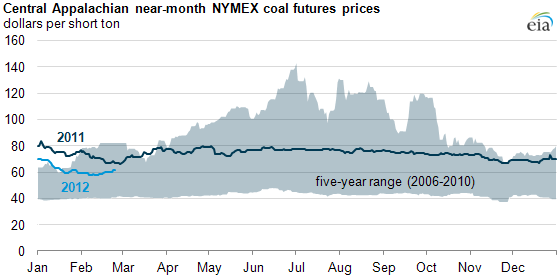
The futures price for Central Appalachian coal, which is the main source of bituminous coal in the eastern United States, is down sharply so far in 2012, as coal demand by utilities declines due to a warm winter and low natural gas prices.
The 2012 futures price for Central Appalachian coal declined 11.7% toward the end of February, falling from $69.67 per short ton at the beginning of the year to $61.50 per short ton at the close of trading on February 24 at the New York Mercantile Exchange (see chart above). The average price for January 1, 2012 through February 24, 2012 of $61.69 per short ton for the NYMEX coal futures contract was down 16.3% from the average price of $73.72 per short ton in the same period last year.
The decline in coal prices reflects, in part, the expectation that the drop in the amount of electricity generated by coal will continue. The volume of coal consumed by the U.S. electric power sector is expected to decline by 1.3% during the first quarter of 2012 compared to the same period last year, while natural gas use by the power sector is forecast to rise by 12%, according to EIA's February Short-Term Energy Outlook.
In addition, warmer-than-normal temperatures this winter are expected to reduce household demand for electric heat, lowering coal use in the electric power sector. The Short-Term Energy Outlook projects U.S. households that rely primarily on electricity for heating will use on average 5.4% less electric heating this winter compared to last winter, and are forecast to have the lowest winter electric heat demand in ten years.
Lower natural gas prices could be contributing to lower coal prices. Estimated natural gas use for power generation is up about 20% so far in 2012 (January 1-February 24) compared to the same period in 2011 despite fewer heating degree days, according to Bentek Energy, LLC. Increased gas-fired generation may be displacing coal use at electric power plants.