U.S. Energy Information Administration logo
Skip to sub-navigation
February 22, 2012

Pacific Northwest water supply forecast to be near or below normal for 2012
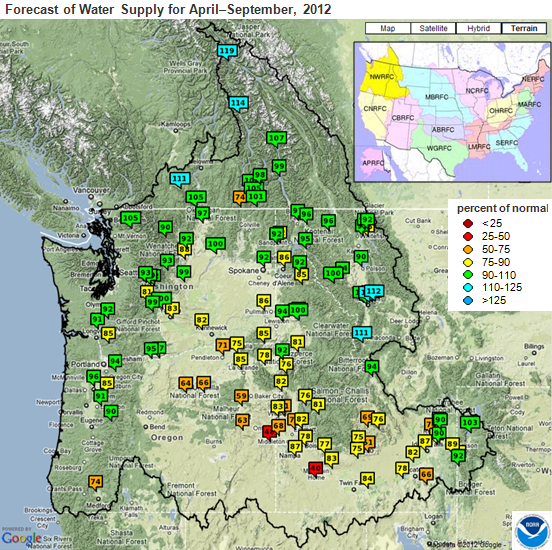
map of Forecast of Water Supply for April-September, 2012, as described in the article text
Source: National Oceanic and Atmospheric Administration, Northwest River Forecast Center.

The Northwest River Forecast Center's latest forecasts for 2012 show near- or below-normal water supply for April to September (the typical high hydro season). The map above shows observation stations in the watershed region of the Pacific Northwest with forecasts for the percent of normal water supply for that station. The colors of the stations represent forecasted water supply levels above normal (blue), near normal (green and yellow), or below normal (orange and red).

Significant quantities of water flowing in the Northwest are used to generate electricity. As such, water supply forecasts are particularly important for operators of electric generators in this region.

The overall water supply is broadly made up of the precipitation that falls in a given time period, the snowpack held throughout a watershed, and the subsequent runoff of the melting snow in the watershed. Each of these phases in the water cycle has observed data tracked by the Northwest River Forecast Center (NWRFC).

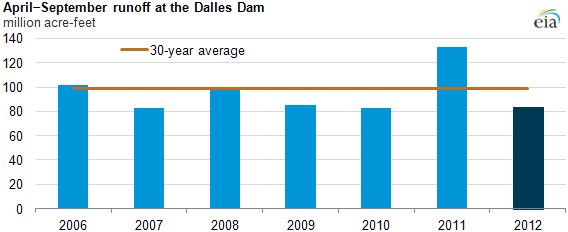
Forecasts of runoff volumes at dams with hydroelectric generators are of particular interest to operators of hydroelectric generators. The water volumes for the Dalles Dam, a centrally located run-of-river dam on the Columbia River, is forecasted to be below the 30-year average for April through September.
graph of April-September runoff at the Dalles Dam, as described in the article text
Source: U.S. Energy Information Administration, based on National Oceanic and Atmospheric Administration, Northwest River Forecast Center.
Note: 2006-2011 are actual volumes. For 2012, the NWRFC forecast as of 2/15/2012 predicts a 90% chance runoff will meet or exceed the level shown above.
Download CSV Data

Hydroelectric supply has significant price effects as well as implications for the dispatch of other generators (such as wind turbines and thermal generators) in the Pacific Northwest. In contrast to a relatively low output from hydropower this coming summer, hydroelectric output in 2011 was significantly above normal levels well into the summer, an unusual occurrence that drove down wholesale electricity prices in much of the western United States.

Statistics
Analysis
Tools
Education
News

Petroleum & Other Liquids

Crude oil, gasoline, heating oil, diesel, propane, and other liquids including biofuels and natural gas liquids.

Natural Gas

Exploration and reserves, storage, imports and exports, production, prices, sales.

Electricity

Sales, revenue and prices, power plants, fuel use, stocks, generation, trade, demand & emissions.

Coal

Reserves, production, prices, employment and productivity, distribution, stocks, imports and exports.

Nuclear & Uranium

Uranium fuel, nuclear reactors, generation, spent fuel.

Renewable & Alternative Fuels

Includes hydropower, solar, wind, geothermal, biomass and ethanol.

EIA Survey Forms

Forms EIA uses to collect energy data including descriptions, links to survey instructions, and additional information.

Total Energy

Comprehensive data summaries, comparisons, analysis, and projections integrated across all energy sources.

U.S. States

State energy information, including overviews, rankings, data, and analyses.

International

International energy information, including overviews, rankings, data, and analyses.

Environment

Greenhouse gas data, voluntary reporting, electric power plant emissions.

Data Tools, Apps, & Maps

Tools to customize searches, view specific data sets, study detailed documentation, and access time-series data.

Open Data

EIA's free and open data available as API, Excel add-in, bulk files, and widgets

EIA Beta

Come test out some of the products still in development and let us know what you think!

Open Source Code

EIA's open source code, available on GitHub.

RSS Feeds

Subscribe to feeds for updates on EIA products including Today in Energy and What's New.