
Crude oil prices increased in 2021 as global crude oil demand outpaced supply
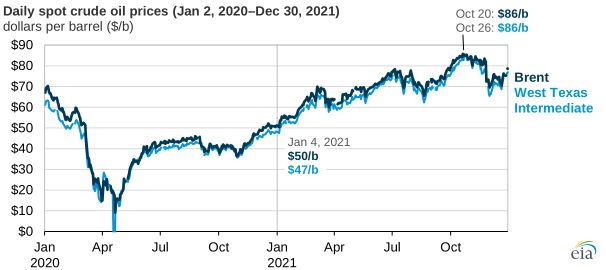
Crude oil prices increased in 2021 as increasing COVID-19 vaccination rates, loosening pandemic-related restrictions, and a growing economy resulted in global petroleum demand rising faster than petroleum supply. The spot price of Brent crude oil, a global benchmark, started the year at $50 per barrel (b) and increased to a high of $86/b in late October before declining in the final weeks of the year.
Brent’s 2021 annual average of $71/b is the highest in the past three years. The price of West Texas Intermediate (WTI) crude oil traced a similar pattern to Brent and averaged $3/b less than Brent in 2021.
Global petroleum production increased more slowly than demand, driving higher prices. The slower increase in production was mostly attributable to OPEC+ crude oil production cuts that started in late 2020. OPEC and other countries, such as Russia, that coordinate production with OPEC (referred to as OPEC+) announced in December 2020 that they would continue to limit production increases throughout 2021 to support higher crude oil prices.
According to our December 2021 Short-Term Energy Outlook (STEO) estimates, U.S. crude oil production in 2021 decreased by 0.1 million barrels per day (b/d) from 2020 and by 1.1 million b/d from 2019. Cold weather in February and hurricanes in August contributed to this decrease, but it also was a result of the decline in investment among U.S. oil producers since mid-2020.
Increasing demand and lower supply of crude oil resulted in consistent global petroleum and liquid fuels inventory withdrawals from February through December and contributed to increasing crude oil prices. The largest inventory draw was in February, when Saudi Arabia imposed a cut of 1.0 million b/d on its production, and the United States experienced extremely cold weather that led to well freeze-offs and a 1.3 million b/d decline in crude oil production.
Withdrawals were also high in June, one month before OPEC+ announced it would begin increasing crude oil production each month. We estimated in our December 2021 STEO that petroleum inventories decreased by 469 million barrels globally in 2021—likely the largest annual inventory withdrawal since 2007.
Principal contributor: Jimmy Troderman