
New UAE-based crude oil futures contract introduced in March
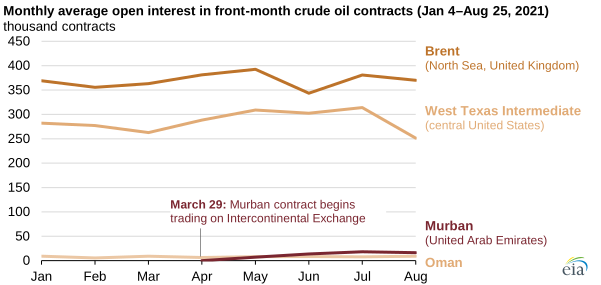
On March 29, 2021, the Intercontinental Exchange, Inc., (ICE) Futures Abu Dhabi (IFAD) exchange began trading a new Murban crude oil futures contract, which delivers at Fujairah in the United Arab Emirates (UAE), and which may potentially serve as an additional benchmark crude oil contract for crude oil exports out of the Persian Gulf. This new contract represents a potential alternative to other regional contracts, most notably the Dubai Mercantile Exchange (DME) Oman crude oil contract and Platts Dubai crude oil pricing basket.
Both DME Oman and Platts Dubai contracts have had low trading volumes compared with Brent and West Texas Intermediate (WTI), which have historically served as the major benchmarks for crude oil pricing. The Brent contract reflects a basket of North Sea crude oils, and the WTI contract reflects a crude oil stream produced in Texas and southern Oklahoma.
Futures contracts allow market participants to purchase or sell crude oil ahead of a future physical delivery date, which helps them manage the financial risks of price changes between buying or selling a contract and taking crude oil delivery.
Since the IFAD Murban contract began trading at the end of March, the front-month contract has traded at a lower price relative to Brent on average but at a higher price than both WTI and DME Oman.
Low-density, sweeter crudes are often priced higher because they yield more high-value products. Murban, with an API gravity of 40, is lighter (less dense) than Brent, WTI, and DME Oman, but Murban also has a higher sulfur content than Brent and WTI, meaning that it is sourer. The higher sulfur content likely contributes to Murban trading at lower prices relative to Brent.
In addition to crude oil quality, point of delivery also affects crude oil benchmark pricing. For example, WTI usually sells at lower prices relative to the Brent global benchmark because it is priced at landlocked Cushing, Oklahoma. In addition to paying for the crude oil itself, buyers must pay to transport the crude oil to a coastal location if they intend to ship it to overseas export markets. To remain competitive with benchmarks that do not require this extra transportation cost, such as the Brent or Murban contracts, WTI contracts are priced lower.
The Murban Bab Oil Field is an oil field in Abu Dhabi. Murban’s primary physical delivery point is Fujairah, UAE. Fujairah is a coastal oil storage and shipping hub on the UAE’s coastline on the eastern side of the Strait of Hormuz, facing the Gulf of Oman and Arabian Sea. Ships bound for Fujairah do not need to navigate the Strait of Hormuz—a waterway subject to risks of shipping constraints—making Fujairah a more attractive shipping location than other ports within the Persian Gulf that require navigating the Strait of Hormuz.
The UAE currently has 2 million barrels per day (b/d) of Murban crude oil production capacity, approximately half of the country’s total crude oil production. The UAE state oil firm, Abu Dhabi National Oil Company, has committed to supply half of its Murban crude oil to Fujairah for export and plans to increase Murban crude oil production to 2.5 million b/d by 2030.
Principal contributors: Kevin Hack, Jimmy Troderman
Tags: futures, liquid fuels, crude oil, oil/petroleum