
U.S. homes and businesses receive natural gas mostly from local distribution companies
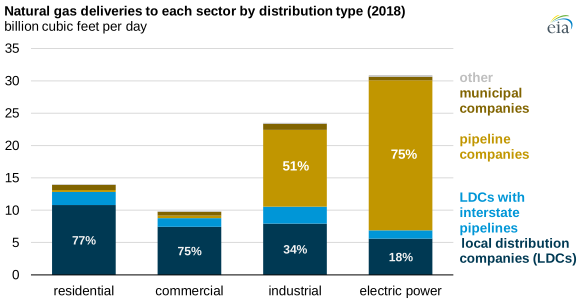
According to the U.S. Energy Information Administration’s (EIA) Natural Gas Annual Respondent Query System, 2,022 natural gas delivery companies delivered natural gas to end-use customers in the United States in 2018. A delivery company is defined as any entity that delivers natural gas directly to end users. In 2018, local distribution companies (LDCs) primarily served homes and businesses, delivering approximately 90%, or 22 billion cubic feet per day (Bcf/d), of end-use natural gas to the residential and commercial sectors. Pipeline companies deliver the highest volume of natural gas to end-use consumers in the United States, predominately to electric power and industrial customers. Natural gas distributors operated by municipalities, referred to here as municipal companies, are the most common type of natural gas distributor in the United States, but they deliver relatively small volumes of end-use natural gas.
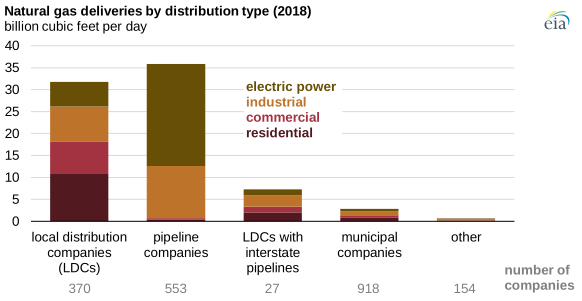
Pipeline companies accounted for almost 75% of natural gas delivered to electric power sector customers and more than 50% of the natural gas delivered to industrial sector customers in 2018. In the United States, 553 pipeline companies were operating in 2018, delivering an average of 65 million cubic feet per day (MMcf/d) directly to end users; however, the largest of these companies delivered more than 2,100 MMcf/d.
Natural gas deliveries are categorized as either transported volumes (the company provides only delivery of the natural gas on behalf of the consumer) or sales volumes (the delivery company takes ownership of the natural gas and then sells it to the final end user). For deliveries to industrial and electric power sector customers, most of the volumes are transported.
Transported volumes are those in which the delivery company delivers natural gas to an end user, but the commodity is sold by another company. Transported volumes are largely delivered by pipeline companies, and they accounted for 86% of industrial deliveries and 94% of electric power sector deliveries in 2018.
Sales volumes are those in which the delivery company provides a bundled service (and price) that includes both the commodity acquisition as well as the transportation to the consumer. Volumes of natural gas consumed in the residential sector are mostly sales volumes, accounting for 86% of total deliveries in that sector. LDCs tend to have larger sales volumes, and pipeline companies tend to have larger transported volumes.
LDCs delivered the majority of the natural gas consumed by residential and commercial customers. Most delivery companies rely on large, high-pressure transmission pipes to bring natural gas most of the way from the wellhead (production site) to customers such as power plants or industrial facilities. LDCs take custody of the natural gas near the market area they serve before delivery to residential and commercial consumers.
Municipal utilities, or natural gas distribution companies owned by a municipality, are relatively small, averaging just 3 MMcf/d of deliveries in 2018, and they accounted for 5% and 6% of residential and commercial deliveries, respectively, in the United States. However, municipal companies account for nearly half the number of all delivery companies, with more than 918 active municipal companies in 2018. Municipal companies are more prevalent in Texas, Tennessee, Louisiana, and Georgia.
More information on company-level data on natural gas distributors is available in EIA’s Natural Gas Annual Respondent Query System.
Principal contributor: Mike Kopalek
Tags: residential, commercial, natural gas, industrial