
Pennsylvania's use of natural gas for power generation has grown rapidly
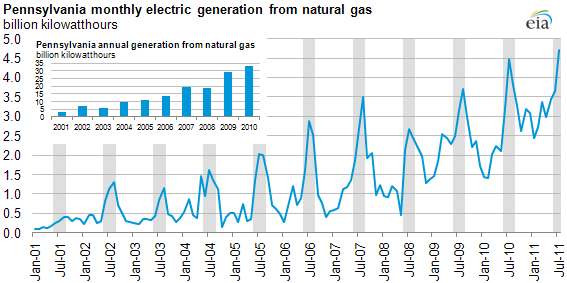
Note: The summer months of June-August are shaded.
Download CSV Data
The amount of natural gas-fired electric generation in Pennsylvania has increased steadily in the past decade, with annual electricity generation from natural gas increasing more than tenfold between 2001 and 2010.
By 2007, a single month (August) of electricity generation from natural gas topped the 2001 annual total (see monthly chart above). The trend continues through 2011, with July reaching a new monthly peak at over 4.7 billion kilowatthours (kWh), although these levels are still well below the amount of coal and nuclear electric generation within the state.
The growth in natural gas-fired generation is reflected in the composition of electric generation in Pennsylvania. In 2001, coal accounted for 57% of Pennsylvania's total generation compared to just 2% for natural gas (see chart below). In contrast, during the first half of 2011, coal made up about 46% of total generation while natural gas generation grew to 17% of total generation.
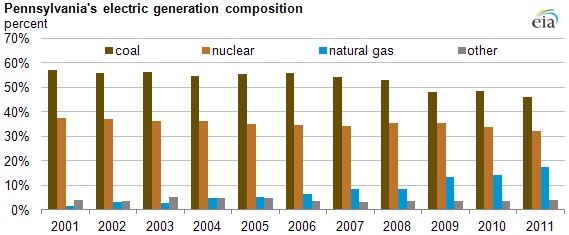
Note: Other mainly includes petroleum, hydroelectric, wind, solar, biomass, and wood.
Download CSV Data
Two factors likely underpin increased natural gas generation in Pennsylvania.
Changes in relative fuel prices. Prices of coal and natural gas are key input costs at electric power plants in Pennsylvania and have taken different trajectories in the last couple of years. Accounting for only the first three quarters of each year, between 2009 and 2011 the NYMEX prompt-month Central Appalachian coal prices were up 54%. Over that same period, prompt-month natural gas futures prices at Henry Hub were up only 8%.
Changes in composition of generating capacity mix. Pennsylvania coal and natural gas generation additions were constructed in two fairly distinct waves. Most coal-fired generation was added in the 1960s-1970s, while the vast majority of its natural gas-fired generation was built since 2001, with new natural gas generators achieving greater operational efficiencies than the older coal generators.
Tags: coal, electricity, generation, natural gas, Pennsylvania, states