
Most of America’s propane exports go to countries in Asia
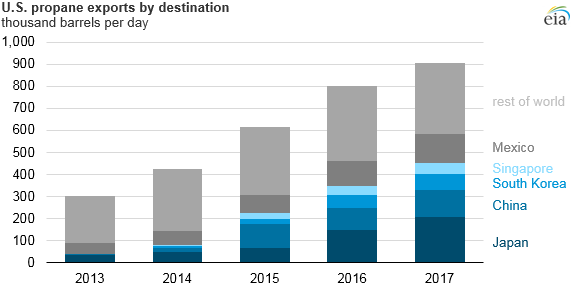
In 2017, the United States exported 905,000 barrels per day (b/d) of propane, with the largest volumes going to supply petrochemical feedstock demand in Asian countries. Four of the top five countries receiving U.S. propane exports are in Asia—Japan, China, South Korea, and Singapore. They collectively imported 452,000 b/d of U.S. propane in 2017, or approximately half of total U.S. propane exports. Overall, propane accounted for 17% of all U.S. petroleum product exports in 2017.
U.S. propane exports to these four countries doubled between 2015 and 2017, displacing some of the region’s propane supplies from the Middle East as well as regional production of propane from refineries and natural gas processing plants.
Investments in petrochemical facilities that use propane as a feedstock in Asia have created an export outlet for U.S. propane supplies. This source of demand, combined with a large and sustained U.S. price discount to the international market, encouraged large investments in U.S. propane export capacity. Propane exports tend to be shipped from ports in the Gulf Coast region. This area (defined by Petroleum Administration for Defense District, or PADD 3) accounted for 90% of all U.S. propane exports in 2017.
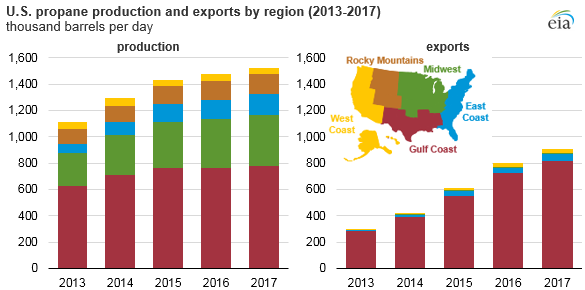
As a result of these investments, between 2010—when the United States became a net exporter of propane—and 2017, gross propane exports increased by 796,000 b/d. By late 2017, in part because of greater U.S. propane exports, U.S. propane prices re-established a closer link with international propane and crude oil prices.
About half of U.S. propane production is from the Gulf Coast (PADD 3). Propane is used mainly for space heating and as a petrochemical feedstock and, to a much smaller extent, for transportation and agriculture. Heating and agricultural consumption are highly seasonal and weather dependent, while petrochemical consumption is highly sensitive to propane prices. Propane is used by the petrochemical industry as a feedstock for producing primarily ethylene and propylene, building blocks for chemical and plastic manufacturing.
Principal contributors: Mason Hamilton, Kelsey Hallahan