
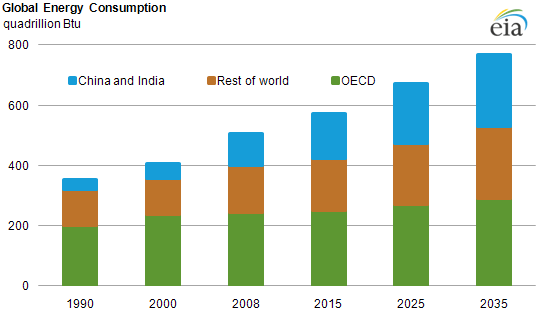
China and India account for half of global energy growth through 2035
Download CSV Data
Strong economic growth leads China and India to more than double their combined energy demand by 2035, accounting for one-half of the world's energy growth according to EIA's recently released International Energy Outlook 2011 (IEO2011). The IEO2011 projects that China and India together will consume 31% of the world's energy in 2035, up from 21% in 2008. China, which surpassed the United States as the world's largest energy consumer in 2009, is the predominant driver of growing energy demand. By 2035, China's projected energy consumption is 68% higher than U.S. energy consumption. Global energy consumption grows 53% between 2008 and 2035, representing an average annual growth rate of 1.6%.
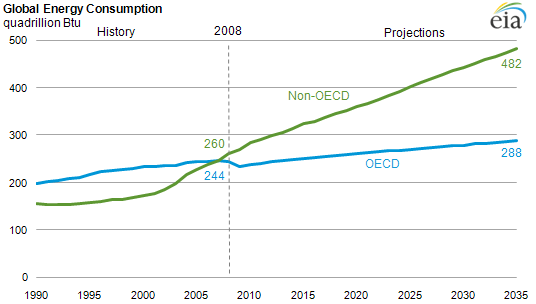
Energy growth varies greatly between developed and developing countries. Energy demand in Organization for Economic Cooperation and Development (OECD) and non-OECD nations, which was nearly the same in 2007, diverges sharply in the projection as non-OECD growth further accelerates, averaging 2.3% per year compared to only 0.6% per year for OECD nations. At this rate, non-OECD nations account for 83% of global growth and consume 67% more energy than OECD nations by 2035, although their energy consumption is still far lower on a per capita basis.
Additional IEO2011 highlights include:
- World oil prices remain high, but consumption of petroleum and other liquids continues to grow; both conventional and unconventional liquid supplies are used to meet rising demand.
- Natural gas has the fastest growth rate (1.6%) among fossil fuels over the 2008-2035 projection period.
- China and, to a lesser extent, India and the other nations of non-OECD Asia consume coal in place of more expensive fuels in the Reference case, which assumes no policy changes that would restrict the use of coal. China alone accounts for 76% of the projected net increase in world coal use, and India and the rest of non-OECD Asia account for another 19% of the increase.
- Renewable energy is projected to be the fastest growing source of primary energy over the next 25 years, but fossil fuels remain the dominant source of energy.
Download CSV Data